
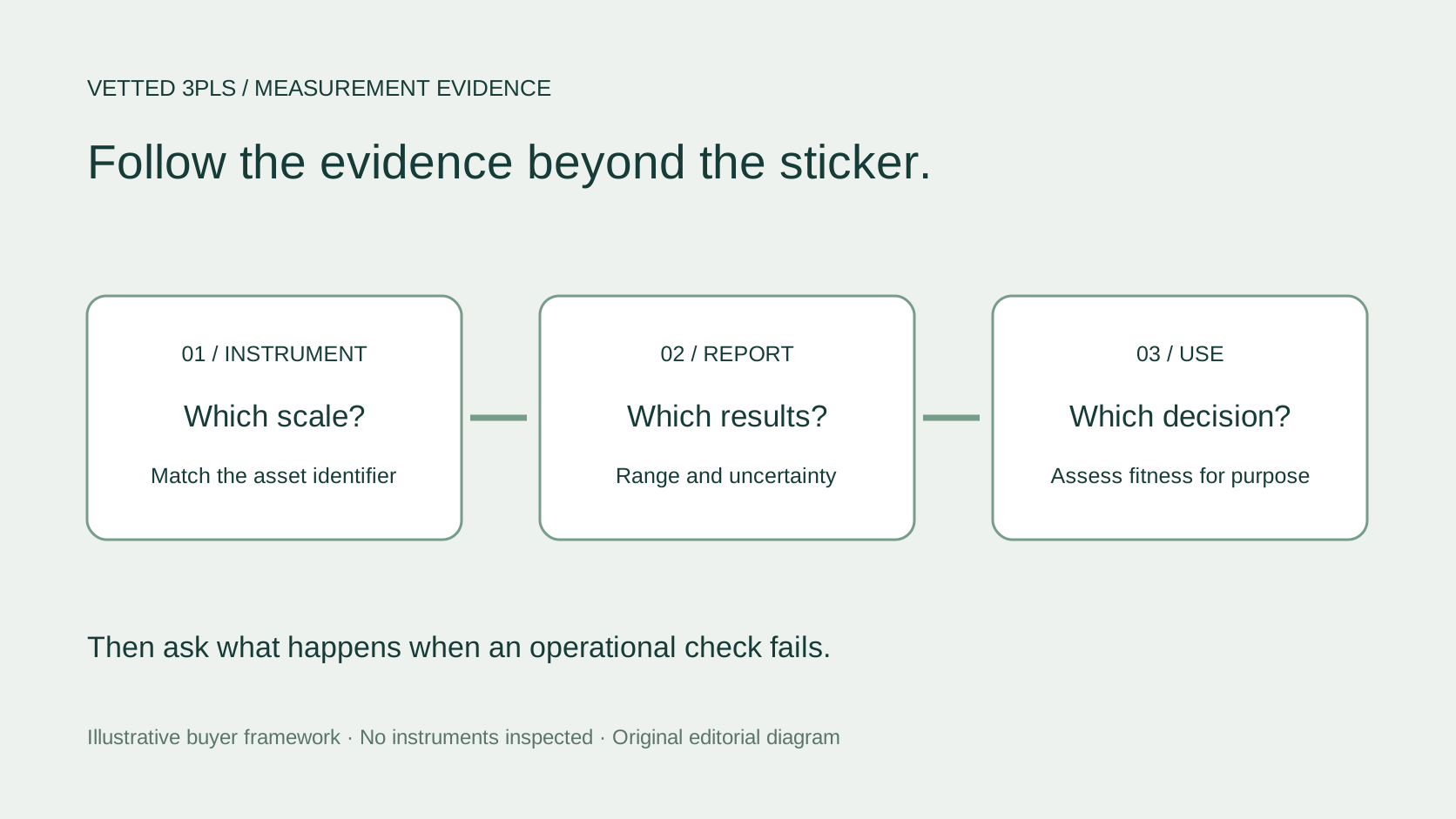
A warehouse tour passes a parcel scale with a current-looking label. That is a useful prompt for a question, not a complete answer about measurement quality. The buyer needs to understand which instrument produced the result and whether the evidence supports the intended use.
NIST’s traceability policy and FAQ connects measurement traceability to a documented calibration chain and measurement uncertainty. It also explains that traceability alone does not guarantee fitness for purpose. This is measurement guidance, not a finding about any warehouse or a statement of local legal-for-trade requirements.
Ask for evidence tied to the actual instrument
Record the scale identifier used at the relevant work station. Ask how it matches the calibration report, what range was assessed, and what the result says. A report for another scale cannot close the question merely because both instruments look alike.
Measurement uncertainty describes the uncertainty associated with a result; it should not be treated as permission to add or subtract whatever amount produces a preferred bill. Ask a qualified person to explain the report and its relevance to the operating range.
Use four questions instead of one sticker check
This original evidence matrix is a desk-designed buyer tool. No instruments or calibration reports were inspected.
| Question | Evidence sought | Decision it supports |
|---|---|---|
| Which scale? | Instrument identifier linked to the report | Correct asset reviewed |
| Which measurements? | Relevant range and conditions | Work falls within supported use |
| How reliable is the result? | Reported results and uncertainty | Suitability for the decision |
| What if a check fails? | Hold, investigation and reassessment process | Earlier affected work can be evaluated |
The matrix deliberately does not prescribe a universal calibration interval or tolerance. Those depend on the measurement task and applicable requirements. Ask how the operator selected its approach and who is responsible for reviewing it.
Test the boundary with two fictional uses
Imagine the same warehouse weighing light retail parcels and much heavier cartons. Evidence relevant to one operating range should not be assumed to answer every question about the other. Likewise, a scale used to estimate transport weight may face different decision needs from an instrument used for a separate product-quality task.
These are hypothetical uses, not a technical determination that either instrument is unsuitable. The exercise is intended to uncover the missing link between a general assurance and the measurement the brand depends on.
Include the response to a failed check
Ask what happens to the station when an operational check raises concern. Who decides whether work can continue? How are potentially affected measurements identified? What evidence supports returning the instrument to service?
The strongest diligence file connects the instrument, its supporting evidence and the response process. It does not turn a sticker into a certification of the entire warehouse. Preserve unknowns and have technical or regulatory questions reviewed by the appropriate specialist before treating them as resolved.
Related reading
Sources
- NIST metrological traceability policy and FAQ — accessed 2026-10-19.