
Ask what the picture actually establishes
A provider may offer a photograph of a sealed trailer as evidence that a warehouse transfer was controlled. It is a useful starting point when the image is linked to the right journey and time. It is not a complete record of what was loaded, what happened during transit or what the receiving warehouse accepted.
Begin due diligence by separating the claims. Was the same conveyance received? Was a particular seal observed? Were the expected logistic units matched? Were their contents and condition checked? Each question needs evidence appropriate to it. One attractive photograph should not be allowed to answer all four.
Connect the journey to the units
The GS1 Logistic Label Guideline describes the Serial Shipping Container Code, or SSCC, as a unique identifier for a logistic unit. It explains how scanning that identifier can connect physical movement with electronic messages. This is an identity mechanism; it does not itself prove the contents or condition of a pallet. GS1 Logistic Label Guideline, section 1.2.1.
Where the operation uses SSCCs, ask to see them linked to the transfer and receiving records. If another agreed identifier is used, ask the provider to explain how uniqueness and continuity are maintained. Do not present an internal pallet nickname as a standards-compliant SSCC.
Review four layers of evidence
We constructed this proposed review framework to distinguish evidence types. It is not a regulatory checklist, certification or finding about a provider.
| Layer | Evidence to request | What remains unproven by that layer alone |
|---|---|---|
| Journey | Transfer reference, conveyance identity and handoff times | Exact goods loaded |
| Seal history | Recorded identifier, observations and any authorized change | Item quantities or hidden damage |
| Logistic units | Expected unit identifiers and departure/arrival matches | Contents of each unit |
| Receipt | Count, condition, discrepancies and disposition | Cause of every difference |
Ask how an authorized seal change is recorded. The useful answer is a documented chain with the reason, responsible party and new identifier, not a promise that changes never occur. The applicable security procedures must be established for the operation and transport arrangement; this article does not prescribe how to inspect or remove a seal.
Use a mismatch to test the explanation
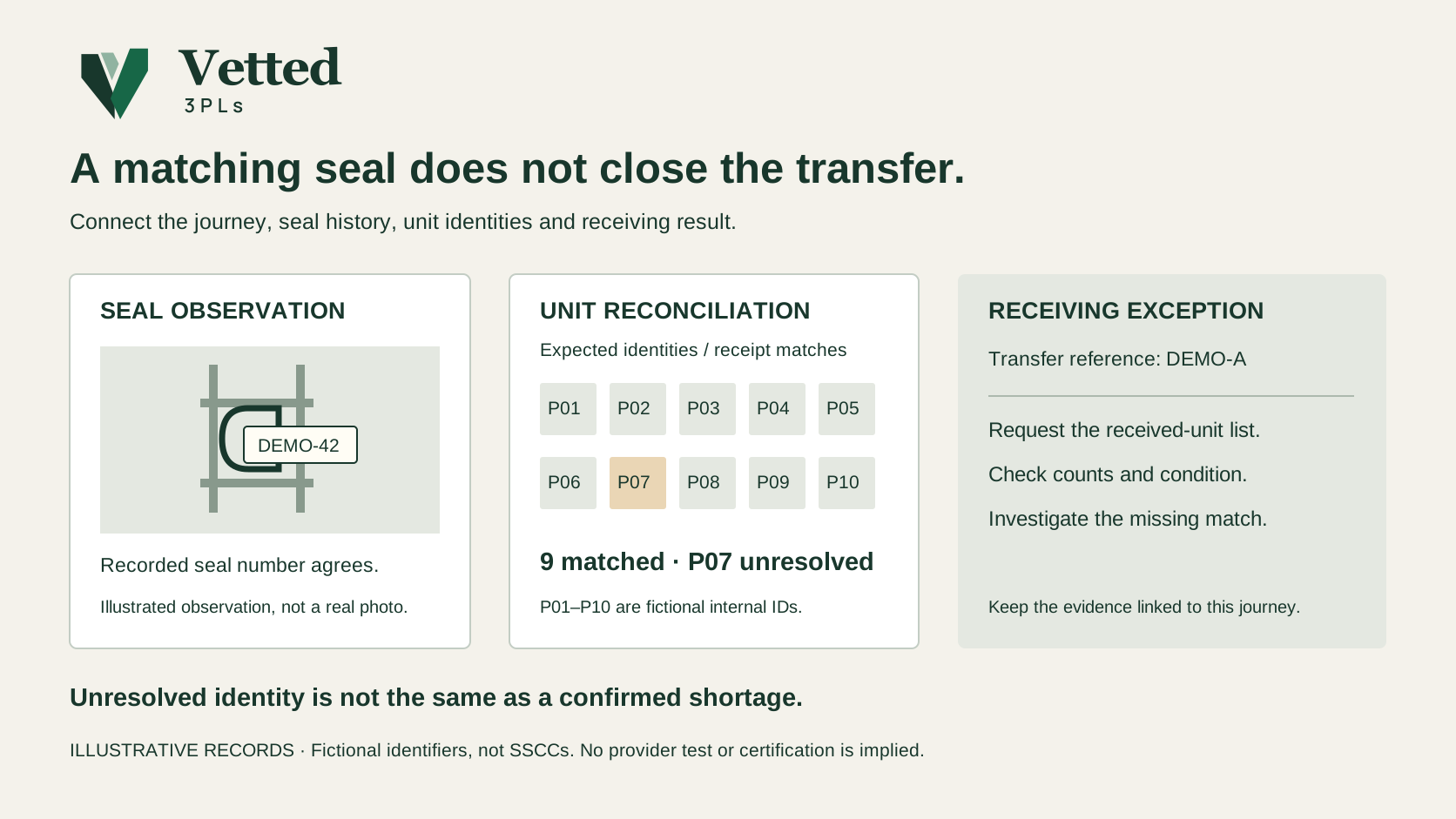
In an invented example, a manifest expects ten pallet identities, P01 through P10. The receipt links nine of them, leaving P07 unmatched. The trailer seal number agrees with the departure record.
The supported conclusion is limited: nine expected pallet identities have receipt matches, and one needs investigation. The seal match does not resolve P07. Nor does the missing match by itself prove a pallet was stolen or lost; a scan omission, record error or physical discrepancy remains to be investigated.
Ask for the next evidence: loading records, the actual received-unit list, counts and an exception case linked to the transfer. Keep “unresolved identity” separate from “confirmed shortage.” Do not close the discrepancy solely because the total number of pallet scans happens to equal ten; a duplicate or unexpected identity could conceal the unmatched unit.
Make the evidence retrievable
Request a bounded, redacted example from a completed transfer, with permission to review it. Check whether the documents share a reference and whether someone can explain conflicting timestamps or identifiers. Agree record retention and who can retrieve evidence when a discrepancy appears after receiving.
For the buyer, the practical selection question is whether the provider can connect observations into a traceable account. A seal photograph may belong in that account. It should not substitute for the rest of it.
Related reading
Sources
- https://ref.gs1.org/guidelines/logistic-label/ — accessed 2026-10-26