
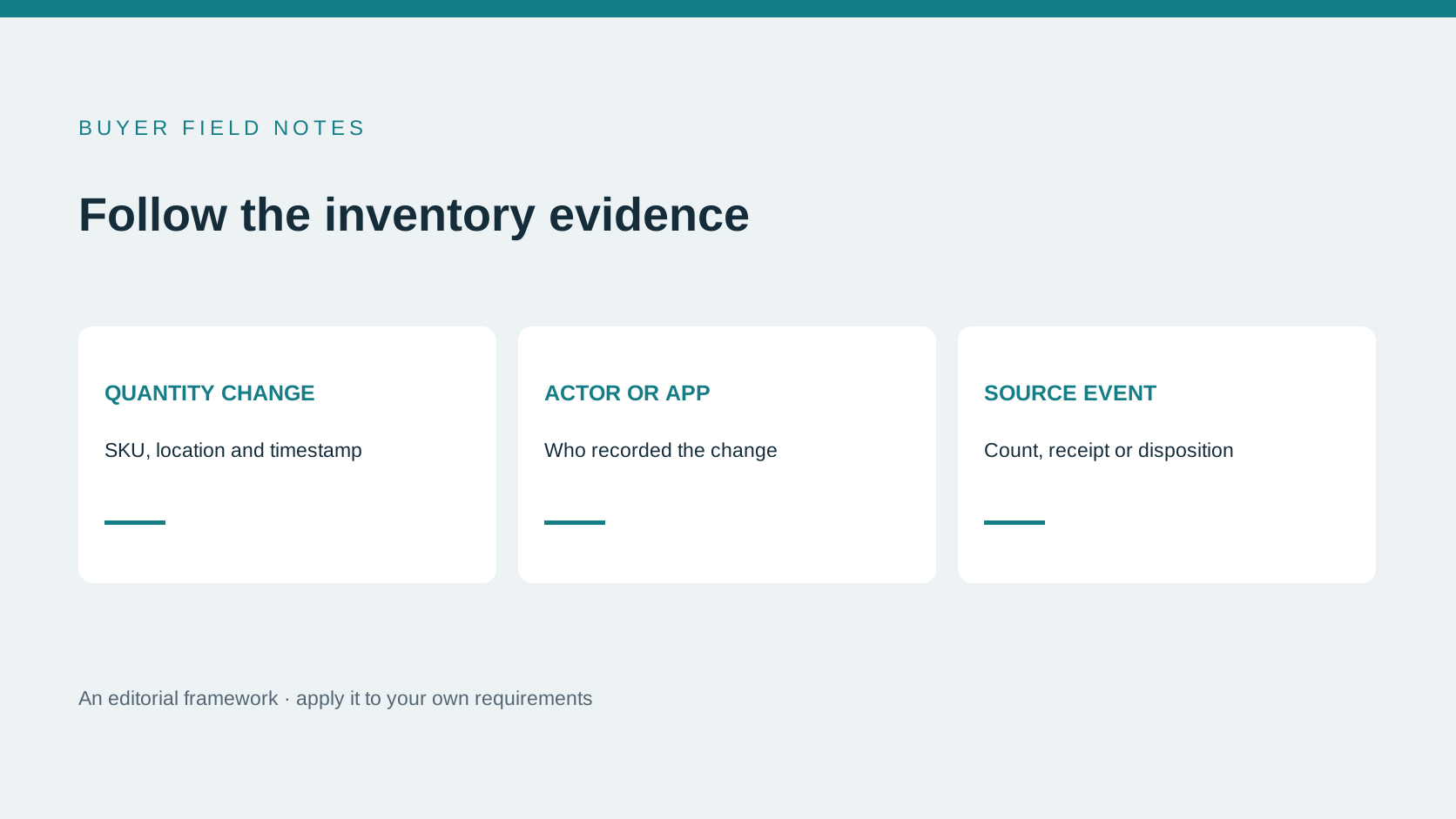
A current inventory balance can be correct while the explanation for an earlier adjustment remains missing. Those are separate questions. Due diligence should ask whether a provider can reconstruct the change, not merely display the present total.
Shopify's product or variant adjustment view covers the last 180 days. Its documentation points to the Inventory adjustment changes report for older history. The 180-day view is therefore not evidence that all older records disappear. It is a reason to identify which retrieval path the team will use. Shopify adjustment history.
Define the evidence before requesting a demonstration
We constructed three fictional evidence packets for the same hypothetical negative-five-unit adjustment and assessed them against five fields: SKU and location, timestamp, quantity delta, actor or app, and a link to the underlying operational event.
| Fictional packet | Fields explicitly present | Unresolved issue |
|---|---|---|
| Current balance screenshot | SKU and location | Does not explain the historical change |
| Adjustment export | SKU/location, time, delta, app | Does not establish why the app changed the quantity |
| Export plus linked count record | All five | Still needs authorization and consistency review |
This is a desk exercise with three invented packets, not an audit of three providers. The progression shows why more data can improve traceability without proving that the adjustment was correct.
A linked count record may itself contain a mistake. The reviewer still needs to compare its scope, unit of measure and approval with the exported adjustment. An app name identifies a participant in the chain; it does not necessarily identify the person who made the original warehouse decision.
Ask for an older example using a defined scope
Propose a demonstration using an adjustment outside the ordinary screen window. Select the SKU, location and date range before the provider retrieves it. Ask which report or warehouse record supplies each field and whether the records use the same timezone.
Do not demand a real customer's confidential data. A provider can use your authorized records, a properly redacted example, or a controlled demonstration. Record what each approach establishes. A demonstration with sample data shows a retrieval process; it does not establish the completeness of historical production records.
Ask for the retention period and export responsibility in writing. Clarify what happens during an integration change or account closure. Avoid treating an available report today as a promise of indefinite access.
Make a narrow acceptance decision
Classify the result as retrievable and linked, retrievable but unlinked, or not demonstrated. These are proposed evidence categories, not certification grades. Keep the missing field visible instead of averaging it into a broad provider score.
If the packet is unlinked, request the specific count, receipt or disposition record needed to finish the chain. If it is unavailable, record that limitation and its business consequence. A brand with frequent high-value adjustments may weigh the same gap differently from a brand with a different inventory profile.
The useful question is not whether a dashboard looks complete. It is whether an authorized reviewer can follow a quantity change back to a comprehensible event.
Related reading
- The documents to request before choosing a 3PL
- 3PL integration access: questions to resolve before connecting your store
Sources
Accessed September 30, 2026. Recheck time-sensitive terms before publication.
- https://help.shopify.com/en/manual/products/inventory/adjusting-inventory/adjustment-history