
Follow the order beyond the first company name
A brand can know its 3PL contact while knowing little about the other organizations involved in processing an order. An overflow operator or shipping software service may have a role that the sales proposal barely describes. The due-diligence question is what information moves, to whom, and under whose responsibility.
NIST's Cybersecurity Framework 2.0 calls for identifying and prioritizing suppliers, understanding external data flows and involving relevant third parties in incident planning. Those are cybersecurity outcomes, not a certification that a warehouse is operationally sound. We use them here to structure buyer questions about order data. NIST CSF 2.0, GV.SC and ID.AM.
Use a three-role map as a starting point
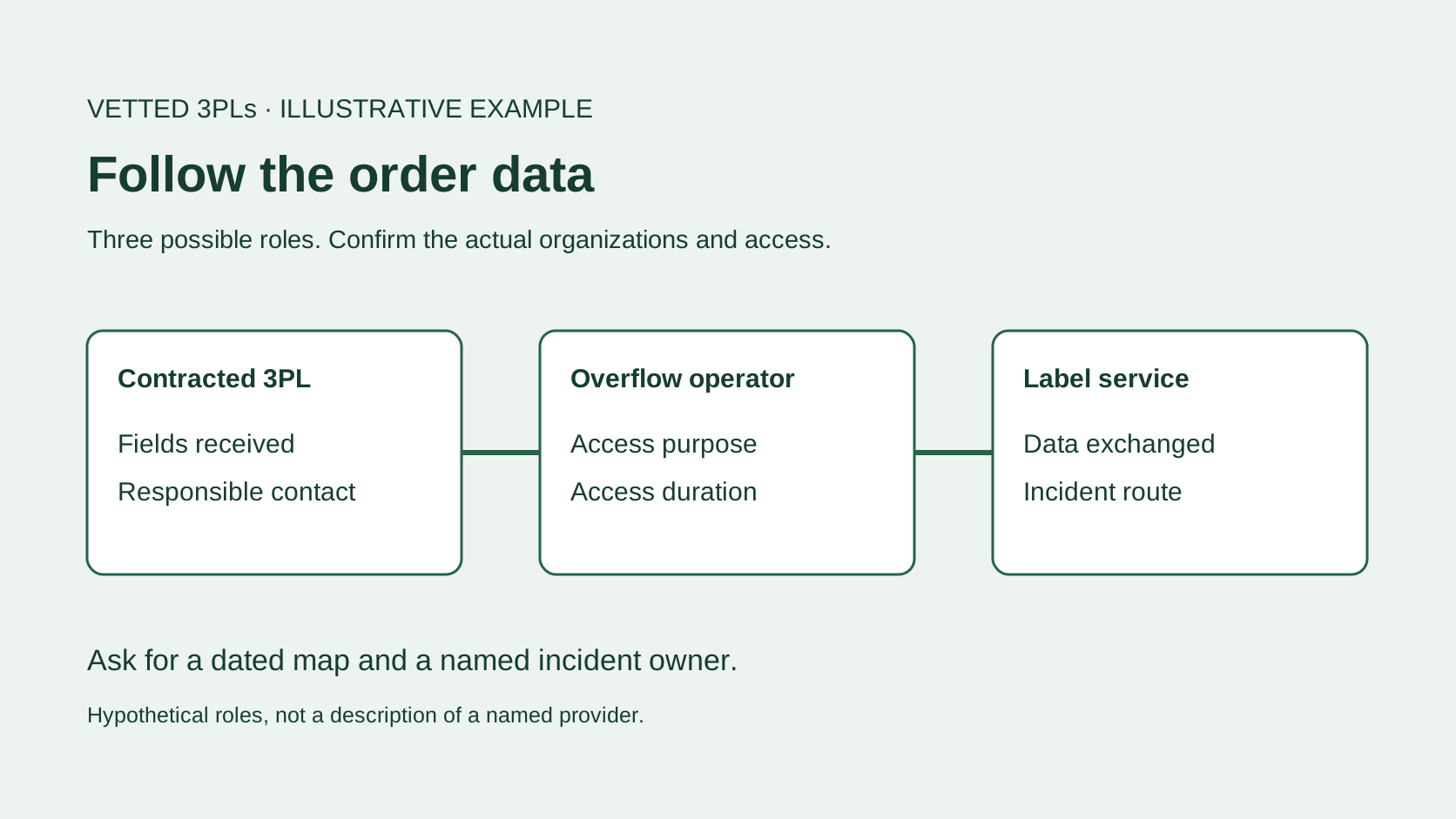
We constructed a hypothetical chain with three roles. It is not a description of any named provider, and a real operation may have fewer or more participants.
| Role | Question to resolve | Useful evidence to request |
|---|---|---|
| Contracted 3PL | Which customer and order fields does it receive? | Approved field list and a redacted flow diagram |
| Overflow warehouse operator | What information accompanies transferred work? | Operator identity, access purpose and responsible contact |
| Label software service | Which fields leave the warehouse system for label creation? | Service identity, documented data exchange and incident route |
The same entity might perform two roles. Record the entity rather than counting boxes in the diagram. Conversely, one software label can hide multiple services. Ask the provider to explain the actual arrangement instead of assuming the illustration is complete.
Distinguish evidence from reassurance
“We only use trusted partners” does not identify a recipient or its permissions. Request a dated record showing organization, purpose, fields received, access duration and the person responsible for updating the record. If some detail cannot be disclosed, ask what alternative evidence is available and keep the remaining gap visible.
Avoid collecting live customer records just to assess this. Redacted examples and field definitions can often answer the initial question. The buyer's aim is to understand access, not to create another unnecessary copy of personal information.
Test the ownership of one hypothetical incident
Suppose the overflow operator reports that an export went to the wrong recipient. Who receives that report at the contracted 3PL? Who informs the brand, preserves relevant records and coordinates containment? Ask for the agreed process and contact ownership. Do not invent a notification deadline; inspect the applicable agreement and obtain appropriate advice where obligations need interpretation.
Repeat the map when a new downstream service or operator is proposed. Treat an unexplained data path as an open diligence item rather than proof of misconduct. A provider that clearly identifies a limitation gives the buyer something concrete to resolve. A broad security claim without scope does not.
Related reading
Sources
- https://nvlpubs.nist.gov/nistpubs/CSWP/NIST.CSWP.29.pdf — accessed 2026-10-16