
Begin with the disputed shipment
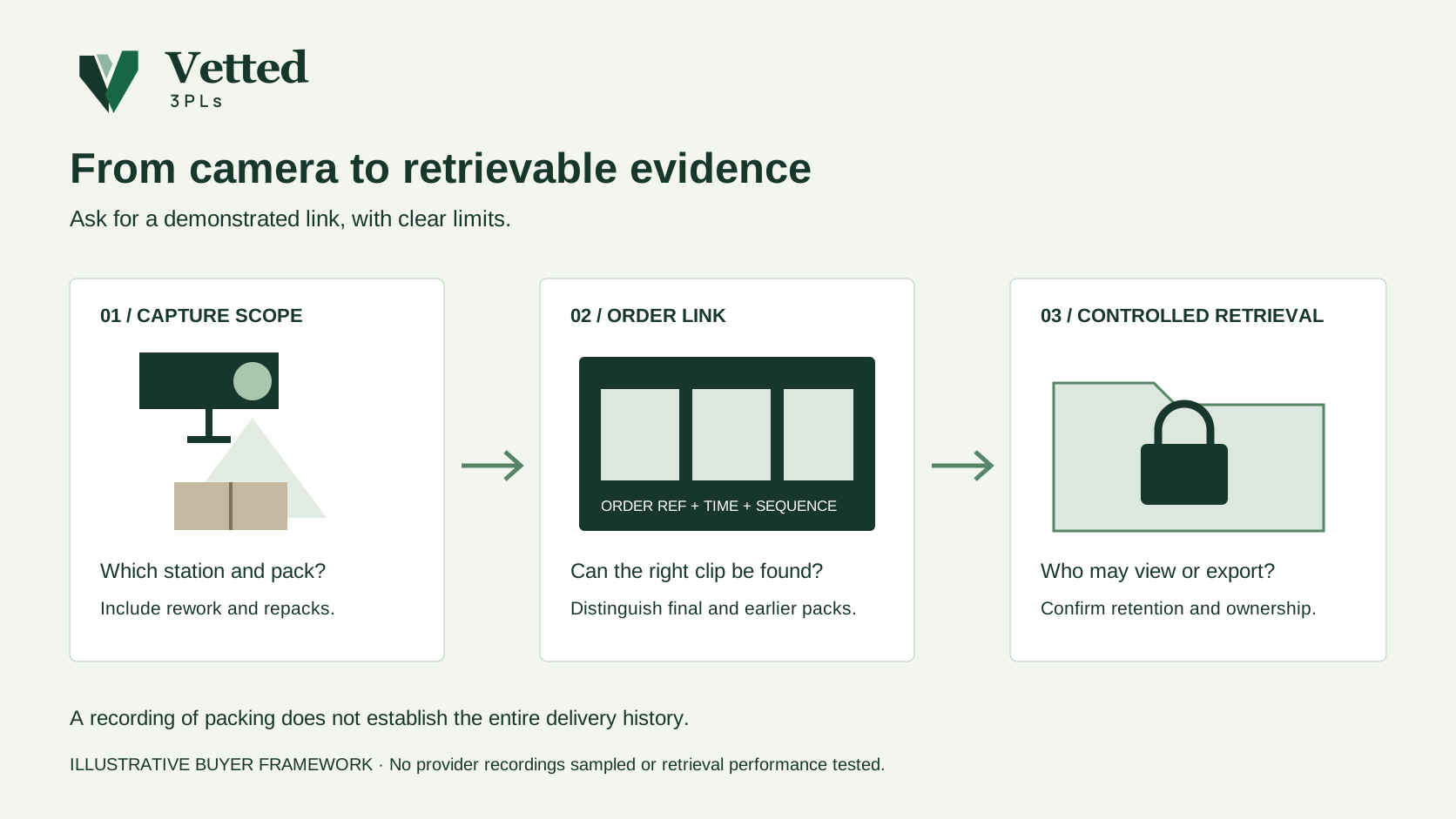
A warehouse may have cameras at its packing stations and still be unable to answer a particular missing-item question. The relevant recording might cover the wrong station, stop before a repack or no longer exist when the complaint arrives. The buyer's question is therefore more specific than whether video is available: can an authorized person retrieve evidence for the shipment being investigated?
Before selecting a 3PL on this capability, ask it to describe the boundary of the claim. Which workstations, shifts and order types are covered? Does the recording show item identity and quantity, or only that someone handled a carton? Does footage follow rework performed elsewhere? Preserve unknown answers as unknown rather than turning them into a positive score.
Use four proposed retrieval cases
We constructed a four-case evaluation worksheet. It is a proposed buyer exercise, not a test we ran. No provider recordings were sampled, and no retrieval performance is claimed.
| Proposed case | Evidence to request | What it can clarify |
|---|---|---|
| Ordinary completed order | Order reference linked to the relevant recording and time | Whether normal retrieval is possible |
| Order repacked after a label change | Original and revised shipment references with the recording sequence | Whether the final pack can be distinguished from an earlier attempt |
| Request near the agreed retention boundary | Demonstration using a permitted test record | Whether the stated retention and retrieval process agree |
| Authorized export for an investigation | Export process and access record using redacted or synthetic data | Who can obtain and share the evidence |
Agree the demonstration conditions in advance. A staged test recording can show how a feature works; it does not establish that historical production shipments were captured. Ask the provider to label which kind of evidence it is presenting.
Separate retention from access
NIST's security-control catalog addresses least privilege, protection of audit information and organization-defined audit-record retention in AC-6, AU-9 and AU-11. Those controls offer useful questions about access and record handling. They do not certify a warehouse camera installation or prescribe a universal packing-video retention period. NIST SP 800-53 control catalog.
Our editorial application is to ask for the provider's actual retention rule, authorized viewer roles and export process. Determine whether the period starts at recording, shipment or another event. Ask how an investigation request affects deletion and who can authorize preservation. The appropriate terms depend on the operation and applicable obligations; the worksheet does not supply a legal retention policy.
Avoid requesting another brand's customer footage to prove capability. Use synthetic orders or a properly authorized, appropriately redacted demonstration. An attractive dashboard should not require exposing names, addresses or unrelated workers to a prospective customer.
State what the recording cannot prove
A clear recording of packing may help investigate the contents at that stage. It does not by itself establish later carrier handover, delivery condition or everything the customer received. Link the video to other relevant records without presenting one source as the whole chain of evidence.
Also ask how the provider handles gaps. A missing recording should produce an explicit limitation and an alternate investigation route, not an inference that the customer's claim is wrong. The commercial response to a complaint remains a separate decision.
Write the capability into the service discussion
Record the scope demonstrated, the unanswered questions, the retrieval owner and any charge for searches or exports. Agree how your team raises a request before the retention window closes. Revisit the arrangement if work moves to a different station or facility.
The useful result is a bounded capability you understand. A modest, well-explained recording process can be more decision-useful than a sweeping evidence promise with no demonstrated retrieval path.
Related reading
Sources
Research accessed October 24, 2026.
- https://csrc.nist.gov/CSRC/media/Projects/risk-management/800-53%20Downloads/800-53r5/SP_800-53_v5_1-derived-OSCAL.pdf