
A report belongs to a configuration
A packaging test report can be useful evidence. Its usefulness depends on whether the tested product, packaging and process match the shipment you want your 3PL to prepare. A familiar logo or the word passed on a summary page does not answer that question.
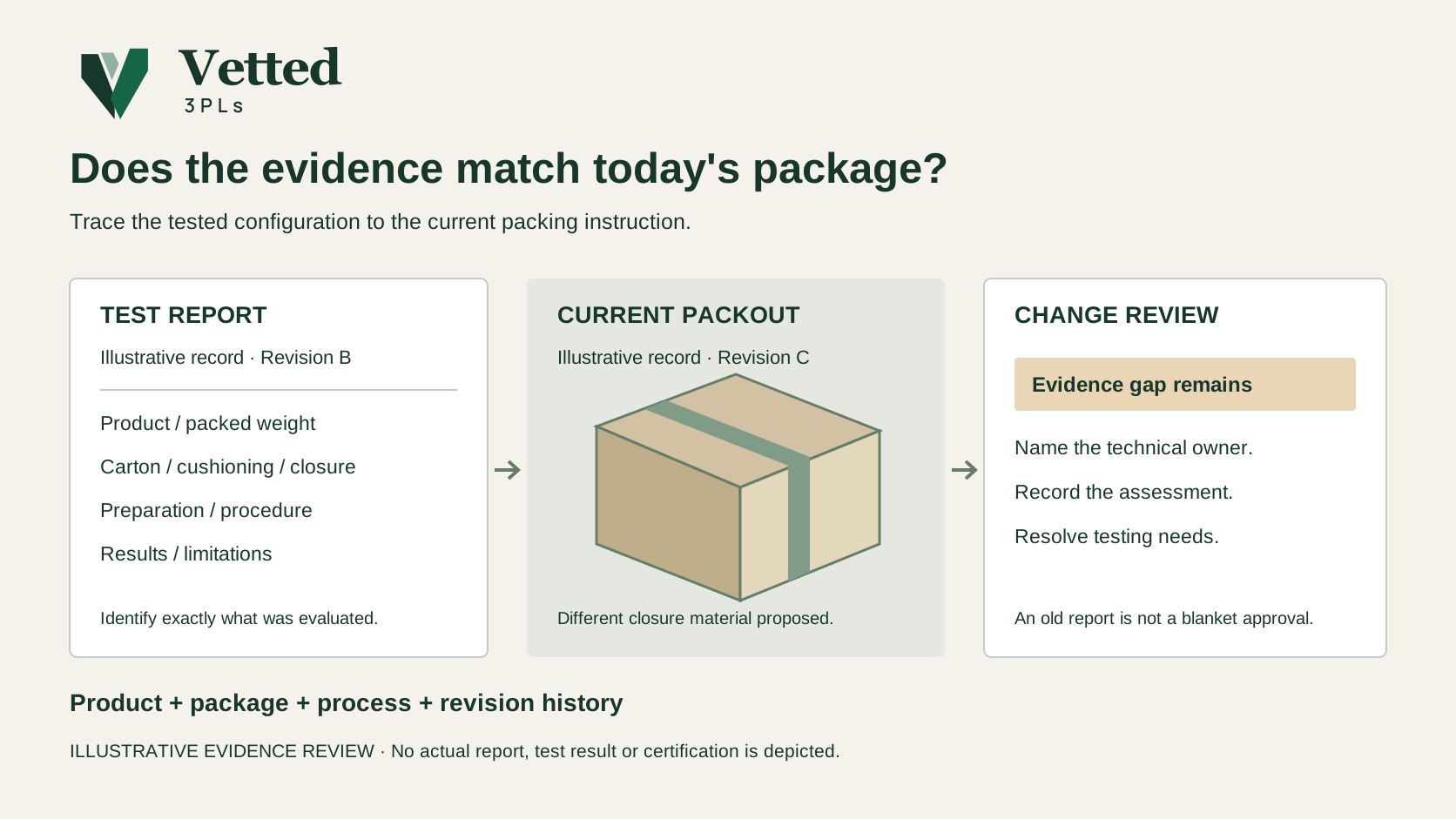
Start by identifying the current packing specification. If the warehouse cannot say which carton, cushioning, closure and work instruction it uses, the buyer cannot make a meaningful comparison with the report. This is an evidence-matching task before it is a claim about protection in transit.
What the primary guidance actually says
ISTA's retesting guidance says protocols should be repeated periodically and when necessary, including changes to the product, package or process, except changes unrelated to potential performance. It identifies dimensions, materials and manufacturing or assembly changes among relevant considerations and advises retesting when in doubt.
That is a reason to review changes explicitly. It does not let a buyer declare every variation harmless, nor does it establish that a particular report certifies every product handled by a warehouse. The appropriate test and technical judgment must come from the responsible qualified parties.
A five-change desk exercise
We constructed the following examples to organize an evidence request. We did not inspect a real report or perform package testing.
| Hypothetical change since testing | Evidence question | Buyer disposition pending review |
|---|---|---|
| Longer outer carton | Does the current dimensional specification match the tested assembly? | Do not assume coverage |
| Different closure tape | Has the closure material and application been assessed? | Obtain documented technical review |
| Heavier product version | Is the current packed product represented by the evidence? | Request the relevant configuration basis |
| Different assembly process | Does the report's preparation match today's documented process? | Resolve the mismatch before relying on the report |
| Invoice wording changed | Can the owner document that the change has no package-performance effect? | Record the reasoning; do not claim a blanket exemption |
The first four examples raise direct configuration questions. The fifth illustrates why a change log needs reasons rather than an automatic retest checkbox. This matrix is our editorial tool, not an ISTA determination about any actual package.
Request the chain of evidence
Ask for the report identifier, date, applicable procedure and version, tested product description, packaging specification and relevant results. Ask who prepared the tested package and who owns the current packing instruction. Redactions may be appropriate, but missing configuration details should remain an identified limitation.
Next, request a change history linking the tested revision to the current revision. For each change, look for a named decision owner, documented rationale and any resulting testing or instruction update. A verbal “same box” is not a substitute for material and dimensional specifications.
Finally, ask the 3PL how operators receive the approved revision and what happens when the specified carton or closure is unavailable. A report-to-specification match has limited operational value if the floor is allowed to substitute materials without a review path.
Make a bounded conclusion
A useful due-diligence conclusion sounds like: “The supplied report matches revision B; the warehouse proposes revision C with a different closure, and the technical review is still outstanding.” It states what the documents establish and what they do not.
Avoid converting this into a provider-wide safety score. Our research reviewed one guidance document and developed five hypothetical change cases. It establishes a practical question set, not the suitability of a package, a laboratory's competence or a provider's performance. Resolve the specific evidence gap with the responsible technical owner before representing the current package as covered.
Related reading
Sources
- Primary source 1 — accessed 2026-10-27.