
Follow the goods as well as the number
A brand approves a stock write-off, the inventory balance falls, and the warehouse ticket closes. That sequence can look complete without answering the physical question: what happened to the goods?
Ask for a chain that connects the instruction to the identified stock and then to the documented outcome. This is particularly useful when the brand must prevent an unwanted resale or distinguish goods awaiting action from goods already processed. The evidence needs to support the specific outcome being claimed.
Know what an adjustment record establishes
Shopify's inventory history supports reasons such as damage and promotion or donation. Those entries help explain recorded quantity changes. They are not, on their own, evidence of a particular physical destruction, donation or removal event. Shopify adjustment history.
Ask which system is authoritative for the physical stock and how the ecommerce balance follows it. If an adjustment is posted before work finishes, the remaining goods still need an identifiable status and location in the warehouse's records.
Reconcile a partial completion explicitly
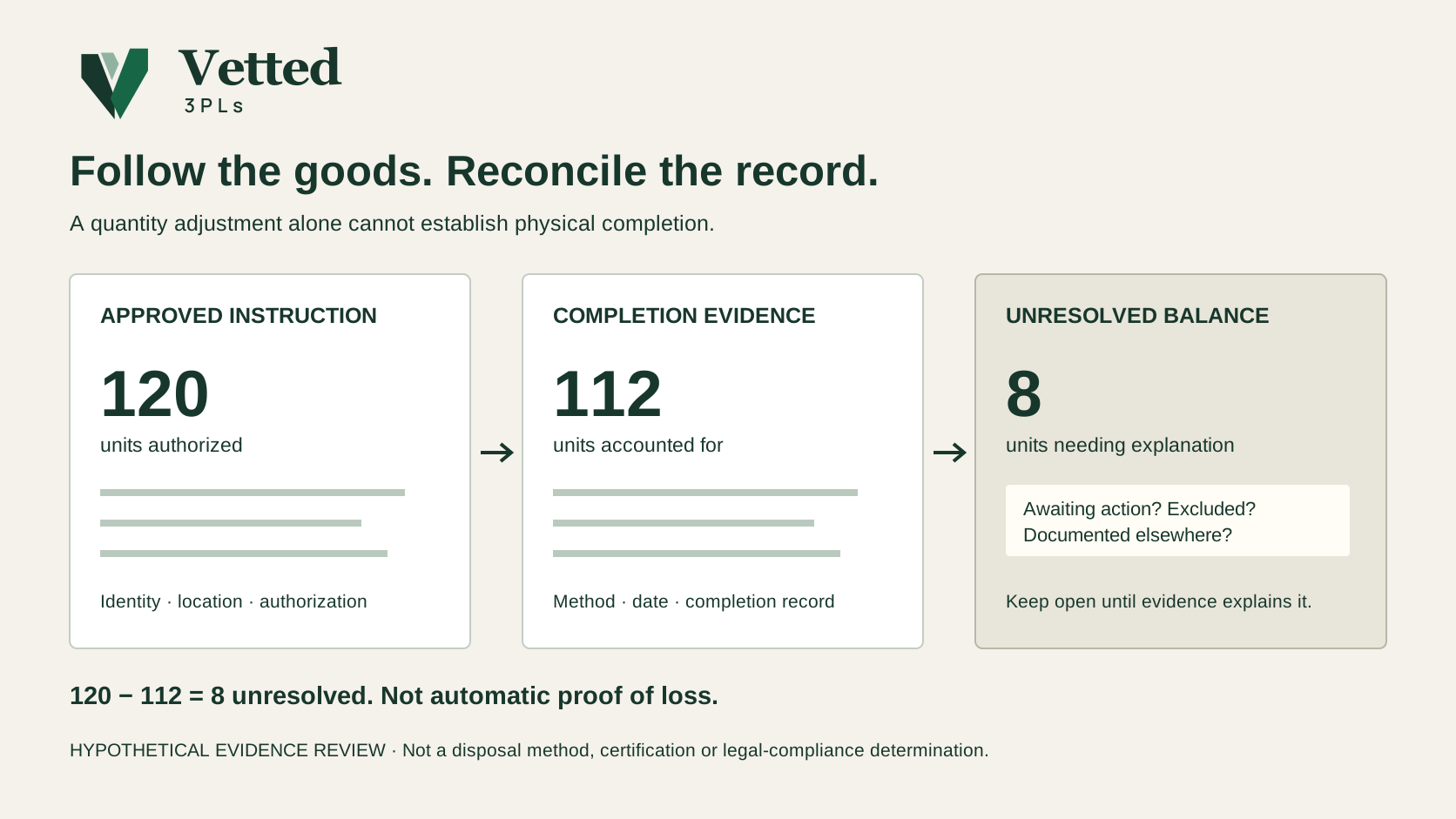
We constructed this hypothetical evidence review:
| Record | Units |
|---|---|
| Brand-approved instruction | 120 |
| Completion evidence accounts for | 112 |
| Remainder requiring explanation | 8 |
The unexplained balance is 120 minus 112, or eight units. It is not automatically proof of loss or misconduct. The remainder could be awaiting action, excluded after review or documented elsewhere. It is a reason to keep the instruction open until the explanation is supported.
A system balance of zero does not answer that question. Nor does a photograph of a pile establish an exact count unless the method and identifiers make the quantity traceable.
Request a connected evidence packet
Our proposed review uses five fields: product identity, quantity and location, approval, physical completion reference, and reconciliation to the system entry. Include lot or serial identifiers where the instruction requires them. Record who approved the action and whether the approved disposition changed.
The completion reference should describe the actual method and date, with records appropriate to that activity. Do not assume a generic certificate establishes every detail. Check whether its scope matches the goods, quantity and location in the instruction. Where another operator performs the work, identify the handover and what evidence comes back.
This is an evidence framework, not a disposal method or a statement of legal compliance. Product-specific environmental, safety and other requirements must be established separately before authorizing the work. Unknown requirements are a reason to hold the action, not improvise it.
Close only the supported portion
Ask the warehouse to distinguish approved, awaiting action, partially complete and reconciled states. Agree who resolves differences and how long supporting records remain available. The brand can then close completed quantities while keeping a visible record of outstanding stock.
A provider's willingness to produce this chain is useful due-diligence information. It does not certify the provider or prove that every historical instruction was handled correctly. Apply the same review to a bounded sample and describe exactly what the records support.
Related reading
Sources
- https://help.shopify.com/en/manual/inventory-and-locations/adjusting-inventory/adjustment-history — accessed 2026-10-25