
A warehouse tour can show spare floor space without showing whether it is appropriate storage space. When a provider offers room for your holiday overflow, ask to see where that inventory will actually go and how the layout will work during a busy shift.
The buyer is not conducting a safety certification. The useful diligence question is narrower: does the operator have a credible process for keeping temporary inventory from undermining safe movement and emergency access?
Temporary stock still needs a suitable place
U.S. OSHA standard 1910.37(a)(3) requires exit routes to remain unobstructed and prohibits placing materials or equipment in them, including temporarily. The same standard addresses maintaining emergency safeguards and exit routes during alterations. These are specific requirements, not a complete warehouse compliance checklist. OSHA 1910.37.
Do not treat a claim that pallets will remain “only overnight” as an answer to an exit-route concern. Ask the operator’s responsible safety person to evaluate the actual layout and applicable requirements. Local requirements and the facility’s circumstances need competent review.
Compare evidence at three moments
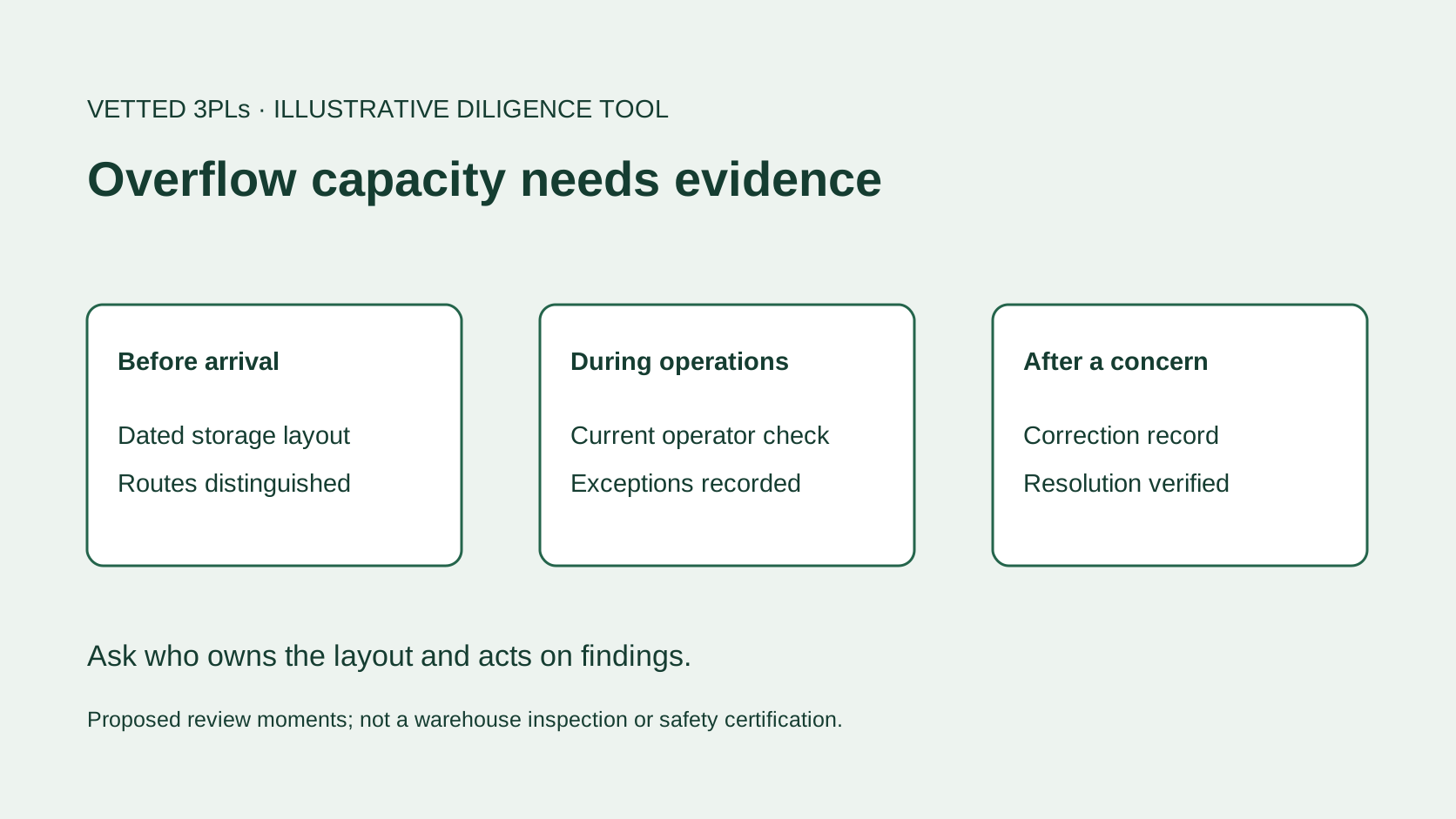
Our original diligence tool uses three proposed review moments. It was built from the cited requirements; no warehouse was inspected.
| Moment | Buyer evidence request | Unresolved question |
|---|---|---|
| Before overflow arrives | Dated layout with storage and routes distinguished | Who approved the proposed placement? |
| During a busy operating period | Operator’s current check and exception record | Does actual staging follow that layout? |
| After a concern is raised | Correction record and verification | Was the cause addressed, or just the photographed pallet moved? |
A tidy photograph is a record of one view at one time. A drawing shows intent. Neither independently proves ongoing compliance. The useful evidence connects planned locations, operating checks and a responsible person who can act on findings.
Ask about the work that competes for space
Returns, empty pallets, packaging supplies and outbound staging all need somewhere to go. Ask what the provider will do when the approved overflow area is full. An answer based entirely on finding another open corner is not a defined capacity plan.
Use a fictional scenario in the review: the afternoon inbound delivery arrives before the morning outbound load leaves. Ask the operator to explain the sequence, the designated holding location and the point at which it refuses or reschedules further receipts. Do not direct workers to move goods or enter restricted areas yourself.
Make evidence affect the selection decision
If a serious concern is visible, raise it with the site’s responsible manager promptly and request documented resolution before relying on the affected space. Record what was seen without claiming a comprehensive legal determination. A professional safety assessment may be needed where suitability is unclear.
For a 3PL buyer, the conclusion is practical: capacity should be supported by an operating layout and a correction process. A quoted pallet count alone does not establish that the proposed space is ready for your inventory.
Related reading
Sources
- OSHA 1910.37: Exit-route maintenance and safeguards — accessed 2026-10-17.