
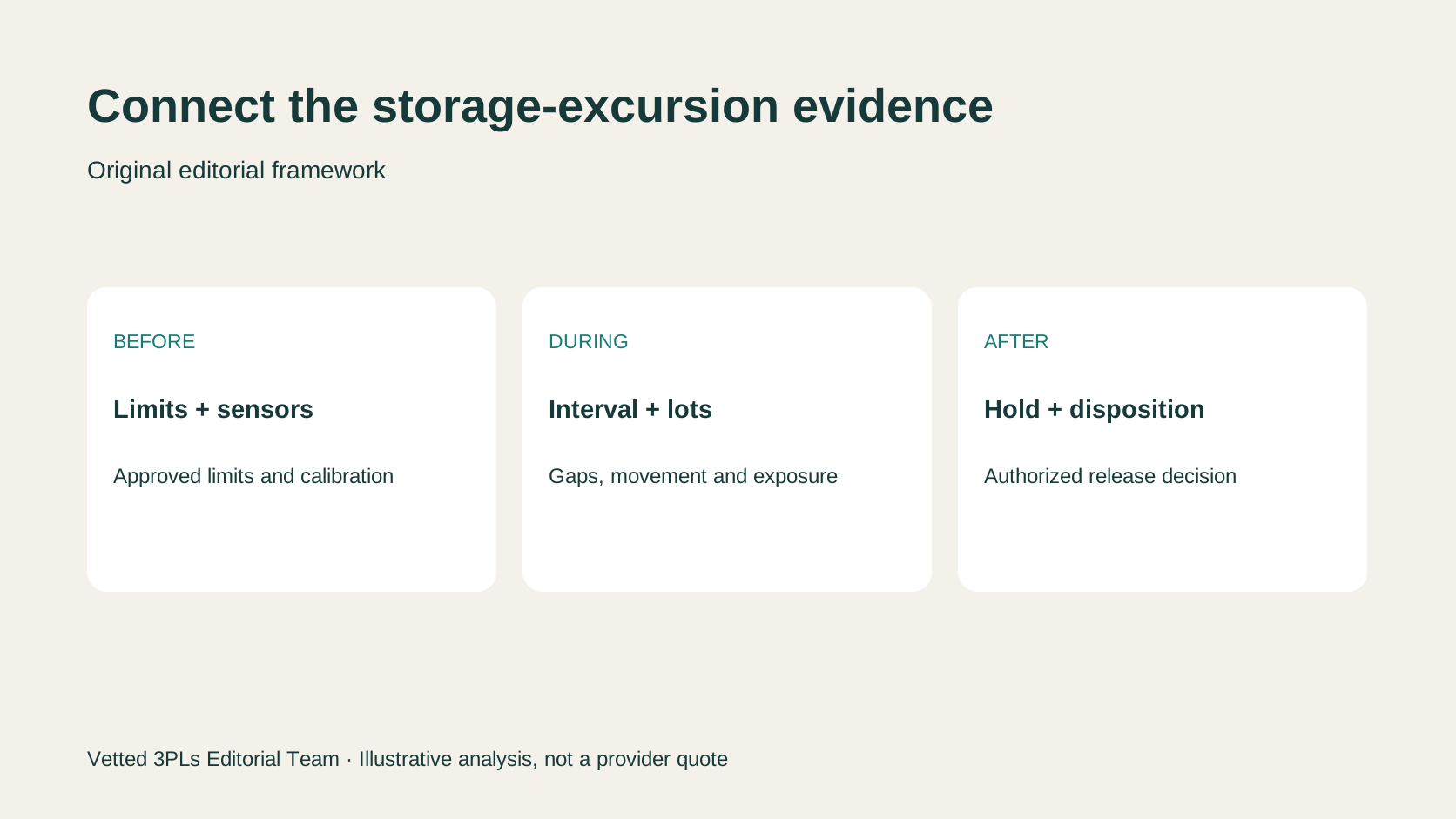
“Temperature controlled” is a useful opening description of a supplement warehouse. It does not tell you what happens when a reading moves outside the product's approved storage conditions.
The due-diligence question is whether the provider can connect that event to the stock affected and the person authorized to decide what happens next. A reassuring average temperature cannot answer those questions on its own.
Start with the product requirements
Ask your product or quality team to supply the applicable storage limits and handling instructions. Do not let a generic warehouse temperature range become your product specification by default. Different formulations and packaging may need different assessments.
The FDA's dietary-supplement CGMP guide describes holding requirements involving appropriate temperature, humidity and light so product characteristics are not adversely affected. It does not provide one universal temperature range for every supplement. Use the product's requirements and the rules applicable to the actual operation when assessing a proposed facility.
Build an evidence chain
For this desk review, we constructed six questions connecting a storage requirement to a disposition decision. This is an editorial due-diligence tool, not a certification checklist or a finding about a particular warehouse.
| Evidence field | Buyer question |
|---|---|
| Approved limits | Which product specification and revision governs the location? |
| Measurement | Which sensor covered the stock, and what supports its measurement reliability? |
| Timing | When did the event begin and end, and are there gaps in the record? |
| Exposure | Which lots were present, and did stock move during the interval? |
| Control | How was affected inventory prevented from being released while reviewed? |
| Disposition | Who decided to release, move or otherwise handle it, and where is that decision recorded? |
A facility can have a temperature log without an adequate answer to every question. Ask to see how the records connect, not merely whether each document exists somewhere.
Compare two hypothetical incident files
File A contains an alarm email and a monthly temperature average. There is no location map, affected-lot list or documented decision. That file identifies a concern but cannot establish which inventory was exposed or what review followed.
File B includes the approved limits, a mapped sensor, the event interval, stock movements, affected lots, a hold record and an authorized disposition. It supports a more traceable investigation. It still does not prove that the product remained suitable: that conclusion requires the relevant product evidence and qualified assessment.
We have not inspected either kind of file at a real facility. The comparison shows why a buyer should ask for connected evidence rather than treating an alarm system as the whole control process.
Include receiving and dispatch
Ask where the control applies. Storage conditions inside the main warehouse do not automatically describe an inbound trailer, a receiving queue or a parcel waiting for collection. Have the provider explain the handoffs covered by its service and the information it expects from you.
Also discuss weekends, power interruptions and sensor failures. Who receives an alert when the usual contact is unavailable? What happens when the measurement record itself is incomplete? These questions help expose responsibility gaps without inventing a universal response-time threshold.
Make the approval specific
Record the facility, product scope, storage requirements and unresolved evidence before approving the arrangement. If a provider cannot supply a meaningful example, mark that item unverified and agree on what would resolve it.
The strongest storage conversation ends with a documented decision path. You should know how the provider will identify potentially affected stock, keep the uncertainty visible and bring the right people into the decision before inventory moves again.
Related reading
Sources
Research checked October 2, 2026. Recheck source-specific requirements before publication.