
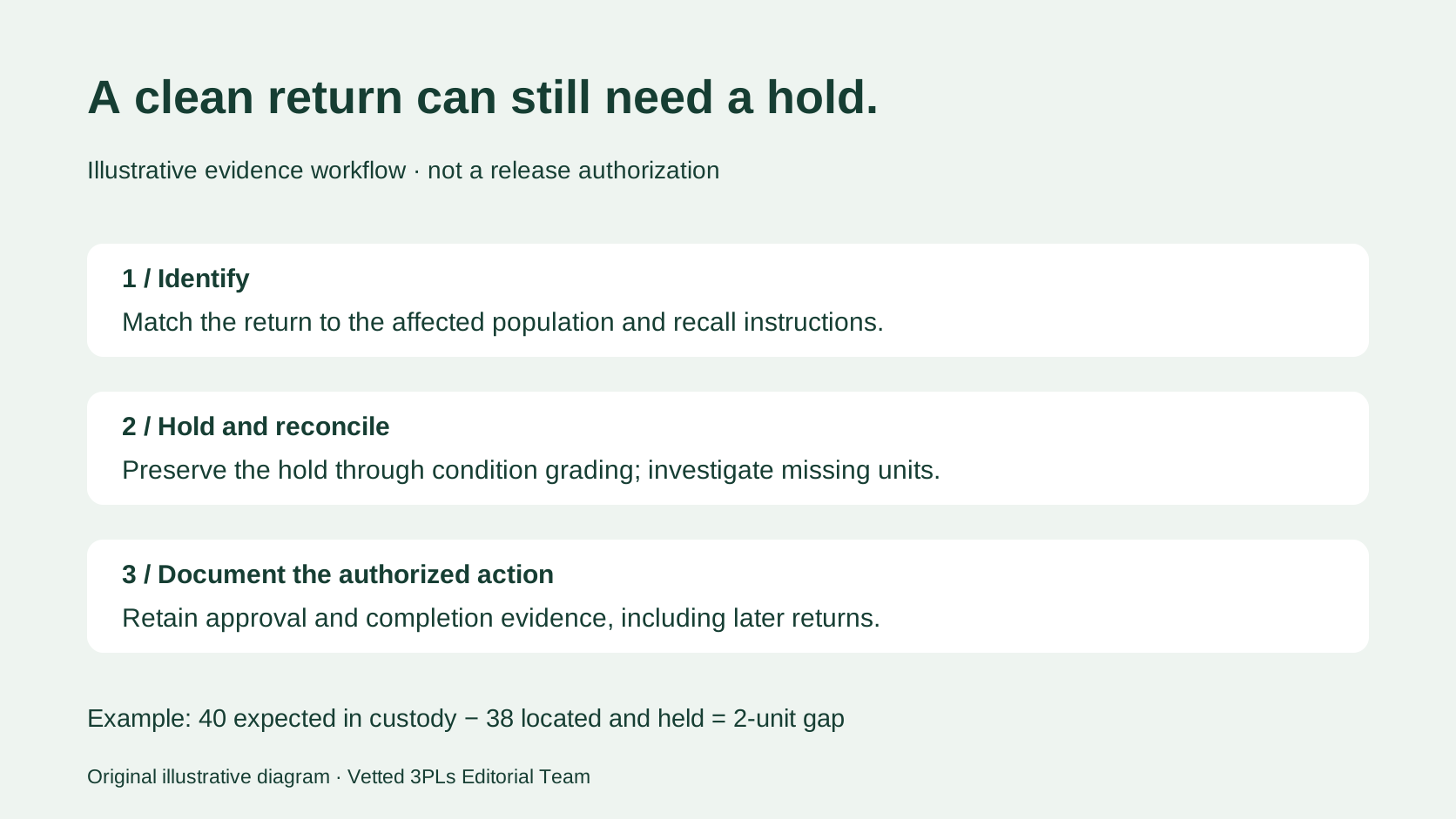
A returned item can look unopened and still belong to an affected recall population. Due diligence should therefore examine more than the condition-grading screen. The buyer needs evidence that product identity and recall instructions follow the item into the return workflow.
CPSC’s guidance for retailers and reverse-logistics providers states that federal law prohibits sale of recalled products and tells firms to monitor recalls. This article addresses that U.S. consumer-product context; other product categories and jurisdictions require their own applicable instructions. CPSC guidance.
Define the affected population first
Start with the actual notice and responsible recall owner’s instructions. Identify the product, model, lot or other identifiers specified there. Do not improvise a narrower scope because the warehouse records are incomplete.
Ask what happens to an item whose identifier cannot be read. Our editorial recommendation is an unresolved hold and escalation, not a guess that puts it back into ordinary stock. The provider should show how that exception remains visible until resolved.
Request one controlled evidence exercise
Use a fictional affected SKU in a safe demonstration environment. Trace an on-hand unit and an incoming return through the proposed controls. This is a suggested buyer exercise; we have not conducted it or audited any provider.
Request evidence of the hold instruction, who applied it, which stock locations it covers and whether the item can still be allocated through each relevant order channel. Then inspect the return workflow: does a good-condition result preserve the hold, or can it overwrite it?
A screenshot of a blocked SKU is only part of the evidence. Ask how stock already picked, held elsewhere or awaiting receipt enters the same process.
Reconcile units without hiding the unknowns
Illustrative accounting exercise: assume 100 affected units originally received, 70 shipped and 30 still at the warehouse when the hold begins. Later, 10 of the shipped units return. With no other movements, warehouse custody should now be 40 and units remaining outside it should be 60.
| Measure at this point | Units |
|---|---|
| Original population | 100 |
| Expected in warehouse custody | 40 |
| Remaining outside warehouse custody | 60 |
| Hypothetically located and held in warehouse | 38 |
| Warehouse reconciliation gap | 2 |
Do not add the 10 returns to the original population: they are movements within it. The two-unit gap needs investigation. “Outside warehouse custody” also does not mean safely recovered or resolved; it only describes this exercise’s location accounting.
Separate a hold from final disposition
A hold prevents ordinary release while instructions and evidence are checked. It does not authorize repair, destruction, donation or resale. Require the responsible party to specify the recall-specific next action and the records that demonstrate completion. Avoid a generic “dispose” status that obscures what happened.
Before closing an exercise, ask who can remove the hold and what approval they must retain. Include later-arriving returns in the procedure so closing the initial investigation does not reopen a route into sellable stock.
The diligence question is not whether a provider promises careful handling. It is whether its records can connect the affected population, current custody, unresolved gaps and authorized actions without treating missing evidence as completion.
Related reading
Sources
- CPSC guidance addresses recalled products and reverse-logistics providers — accessed 2026-10-06.