
An attractive foreign-trade-zone proposal can arrive as a spreadsheet: less cash tied up in duties, perhaps other savings, and a warehouse ready to receive inventory. The diligence work starts before you accept any of those numbers.
For a brand choosing a 3PL, the key question is whether the proposed operation exists in the form the model assumes. A nearby zone, an approved location and an activated warehouse operation are not interchangeable pieces of evidence.
Verify the step that makes the proposal usable
The Foreign-Trade Zones Board's official overview distinguishes Board approval from subsequent CBP activation. Its activation definition covers a site or portion of one and describes review of security and inventory controls. It also says production activity requires specific Board authorization. These distinctions mean a brand should verify the proposed premises and work, rather than infer eligibility from an address or logo.
Ask for the site identity, operating entity, activation evidence and a description of the area where your stock would sit. Have your customs adviser reconcile those records with the actual proposed flow. An application in progress should remain an unresolved dependency in your launch plan.
Build an evidence file around five questions
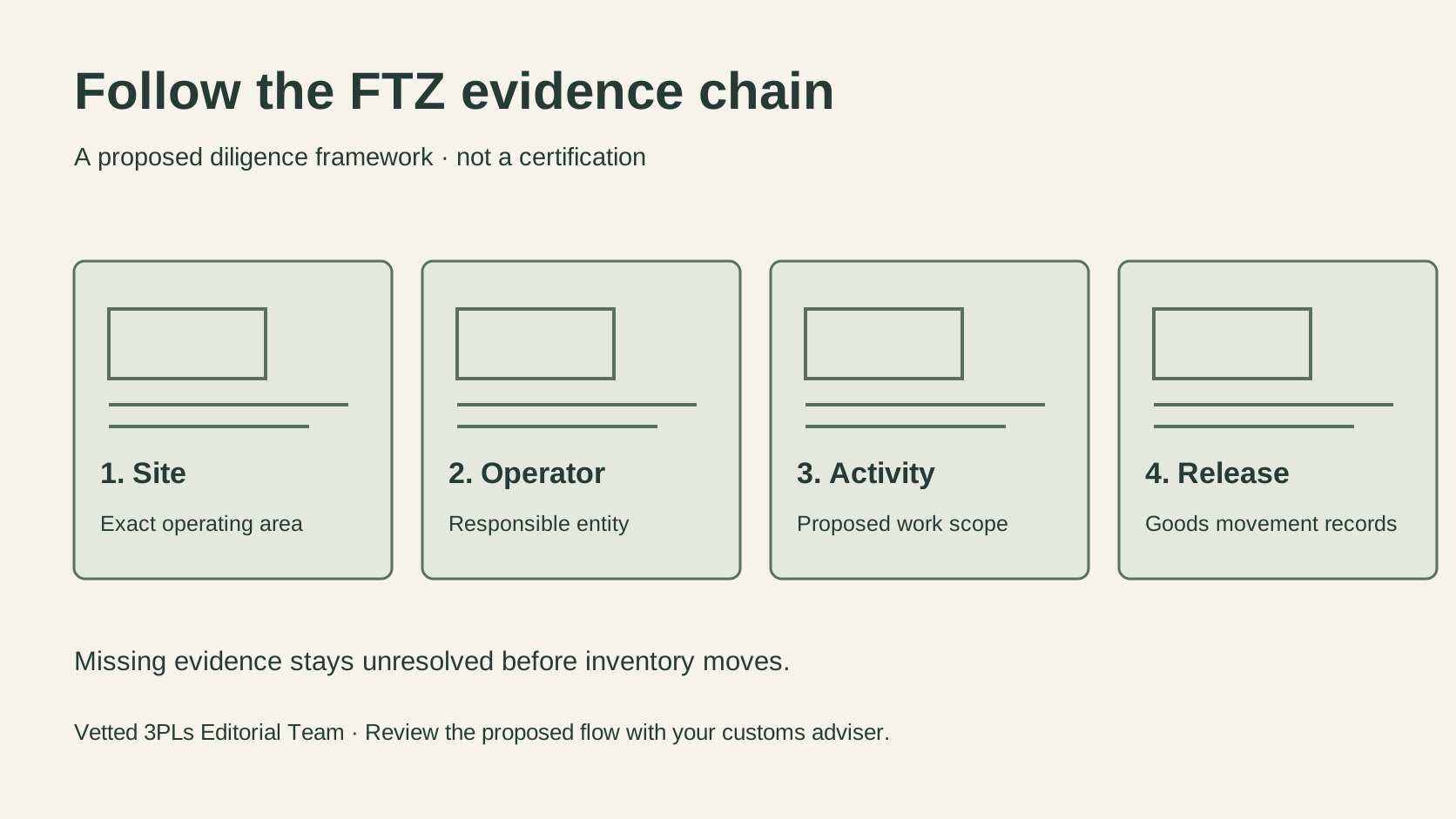
We designed the following five-part desk-review checklist from the official distinctions. It is an editorial diligence tool, not a certification standard. We have not audited any provider or obtained private activation records.
| Question | Evidence to request | What an incomplete answer leaves unknown |
|---|---|---|
| Where will our inventory physically be held? | Site identifier, address and marked operating area | Whether the quoted space matches the proposed operation |
| Who runs that operation? | Named operator and activation documentation for review | Whether the sales contact is describing its own operation or another party's |
| What work will happen to the goods? | Written process covering storage, packing and any production-related activity | Whether the proposed work fits the relevant authority |
| How will each movement be recorded and released? | Example receipt, status, withdrawal and reconciliation records | Whether stock can be traced through the planned workflow |
| Who owns filings, exceptions and charges? | Responsibility matrix, broker arrangement and itemized scope | Whether the savings model omits required work or fees |
A brochure can introduce these questions. It cannot close them. Record “not supplied” when a document is missing and identify who must resolve it before inventory moves.
Walk one hypothetical order through the paperwork
Consider an illustrative imported accessory that will be stored, picked and sent to a U.S. buyer. Ask the 3PL and customs adviser to describe the receipt, recorded customs status, release step and shipment record for that item. Then ask how the record changes if the unit is damaged or exported instead.
The official overview explains that goods move into a zone through admission and leave through entry or transportation-under-bond procedures. It also states that retail trade is prohibited in zones. Do not translate that statement into a blanket conclusion about every ecommerce fulfillment model; get the adviser to explain the compliant withdrawal and sale structure for your particular flow. FTZ Board overview
This walkthrough is not evidence that a proposed model works. It is a way to expose steps that the proposal has not yet explained. Require the relevant specialist to resolve those steps in writing.
Separate deferred cash from permanently avoided cost
In the commercial model, identify which benefit is a timing change and which is an actual reduction under the applicable rules. Ask the adviser to substantiate treatment for the specific merchandise and transaction. Do not apply an example tariff percentage to an entire product catalog or assume every additional tariff follows the same treatment.
Add the operator's fees, broker work, transport, systems, reporting and exception handling. Ask what happens if you move providers or need inventory released urgently. These are requested cost categories, not a claim that every operator bills the same way.
The decision threshold is a traceable chain: the right place, the right operator, the right activity and a workable release process. Once that evidence exists, the cost model becomes worth evaluating. Until then, the headline saving remains a proposal.
Related reading
Sources
- FTZ Board overview: approval, activation, activity and goods movements — accessed 2026-10-03.