
Follow the finding, not the folder
A food warehouse can produce a pest-control contract and still leave a buyer unsure what happens after a problem is detected. The useful diligence question is how the operator connects a finding to an action, a product assessment and a decision that the issue is resolved.
For covered food operations, 21 CFR 117.35(c) addresses pest exclusion and effective protective measures. It does not make the buyer checklist below a mandated form, nor does reviewing paperwork establish legal compliance. 21 CFR 117.35.
Ask the operator to explain the applicable requirements for your products and facility. Use a qualified food-safety adviser where that determination needs specialist judgment.
Request one redacted example
Ask for one completed finding record with confidential details removed. If the warehouse cannot share an actual record, ask for a walkthrough of the procedure and label that evidence as procedural only. Do not treat a blank template as proof that the process has been followed.
Trace five elements: where and when the finding occurred, who took responsibility, what action was documented, how potentially affected stock was assessed, and who authorized closure. These are buyer questions, not instructions for choosing a pesticide or treating a facility.
Compare three evidence states
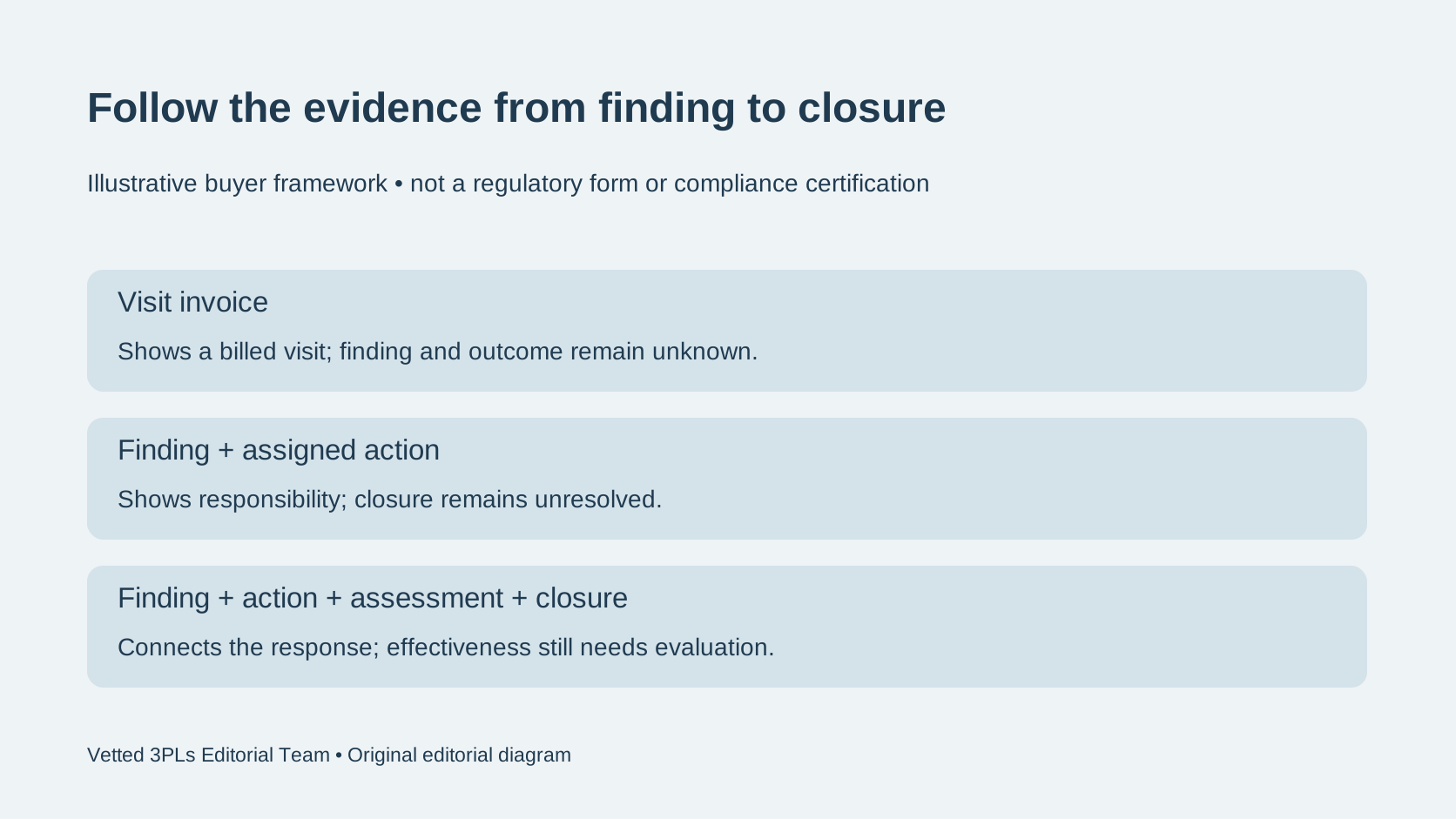
Consider three constructed document packages. Package A contains only a contractor visit invoice. It shows a visit was billed but does not establish the findings or resolution.
Package B contains a finding and an assigned corrective action, but no closure evidence. It gives more visibility while leaving the outcome unknown.
Package C connects the finding, action, product-impact assessment and authorized closure. It supports a more complete follow-up conversation. It still does not prove that a facility has no pests or that every action was effective.
This comparison evaluates completeness of the evidence chain. It does not score real warehouses or rank providers. Unknowns should remain visible rather than being converted into a reassuring check mark.
Test the stock connection
Ask how the warehouse identifies inventory that may be affected and how a hold or release decision reaches the inventory system. Which person can make that decision? What is communicated to the brand, and how is the communication recorded?
Do not assume that the contractor owns product disposition. Identify the operator's responsible decision-maker and the brand's role. An exterminator's service record and a product release decision answer different questions.
Set the follow-up expectation before onboarding
Agree what notification your brand receives, which evidence can be shared and when unresolved actions are escalated. The right cadence depends on the product and operating context; a universal number of hours would be misleading here.
Finally, ask how recurring findings are recognized. A series of closed tickets can still deserve attention when the same location or issue appears repeatedly. The aim is a traceable response that helps you decide what to investigate, not a certificate-like label created from a document review.
Related reading
Sources
- Primary source or planning context — accessed 2026-10-15. 21 CFR 117.35(c) addresses pest exclusion and effective measures in covered food manufacturing, processing, packing and holding areas; the proposed evidence checklist is editorial, not a prescribed regulatory form.