
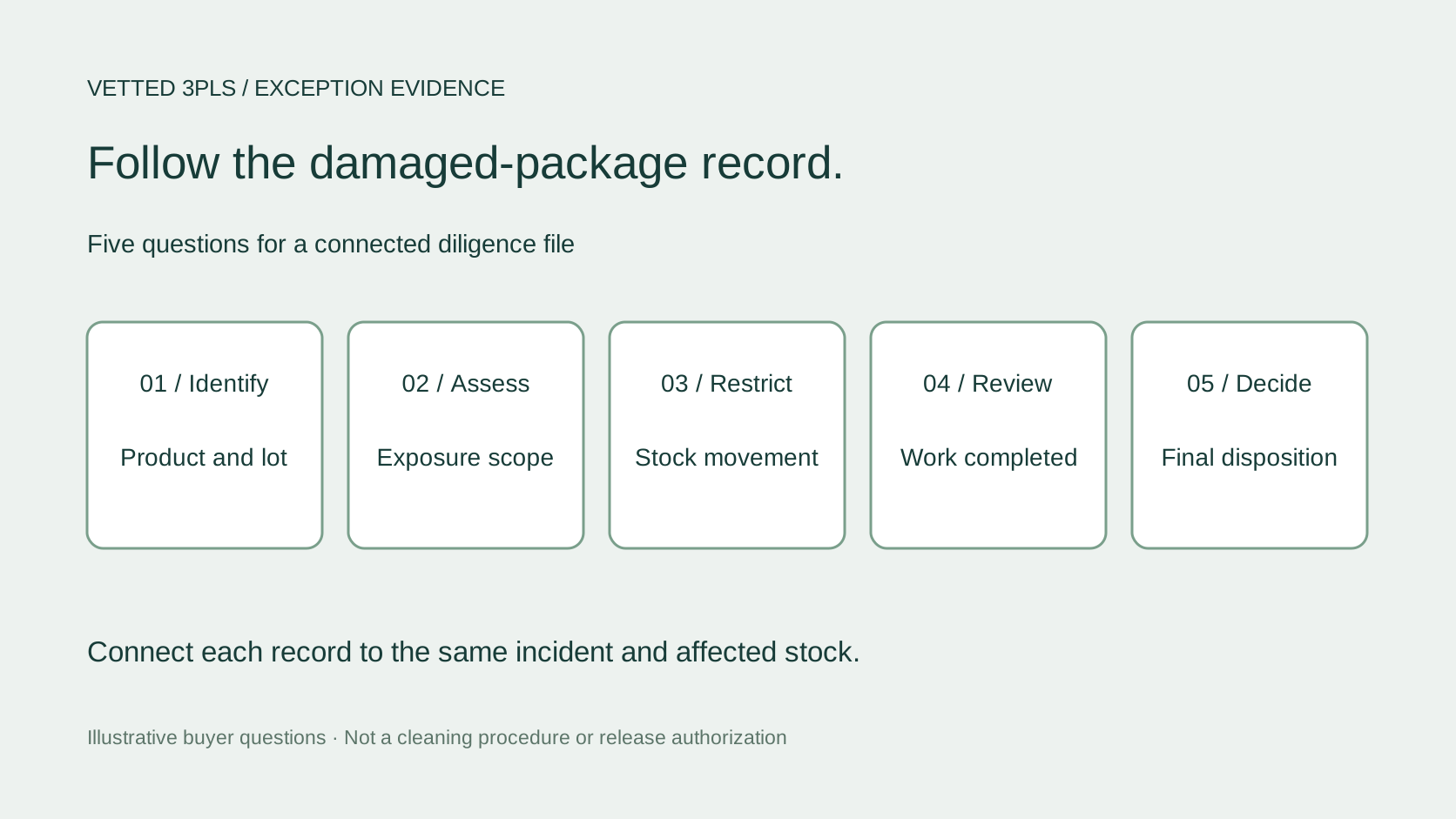
Inspect the exception behind the tidy storage area
A food warehouse can show neat racks and intact cartons during a tour. The more revealing question is what happens when an inner package breaks. Ask the provider to explain how it identifies potentially affected stock, restricts movement and obtains a qualified disposition decision.
For relevant U.S. human-food operations, 21 CFR 117.93 addresses storage and transportation conditions that protect food against allergen cross-contact, contamination and deterioration of food and containers. The regulation provides the objective; it does not certify a particular warehouse or prescribe the evidence checklist below. Applicability and controls depend on the operation and product. eCFR, section 117.93.
Compare two package states
Our desk review translated that objective into evidence questions for two hypothetical situations: an intact sealed carton and a damaged inner package leaking food material. We did not inspect a facility or assess an actual product's safety.
For intact stock, request the storage and handling specification relevant to the product. For the leaking package, ask for the exception process and a redacted record showing how the provider applied it. A general statement that products arrive sealed does not answer what happens after the seal or container fails.
The important distinction is between observing a damaged item and determining the possible scope of exposure. Neighboring stock, handling surfaces and subsequent movement may need assessment by the responsible food-safety personnel. A buyer should ask who makes that assessment, rather than inventing a universal distance or cleaning rule.
Follow five pieces of evidence
| Question | Evidence to request |
|---|---|
| What material and stock were involved? | Product, lot, location and incident identification |
| What else may have been exposed? | Documented assessment and its scope |
| What prevented unintended movement? | Hold or restriction records linked to affected stock |
| What work was completed and checked? | Relevant cleaning and review records |
| Who decided the final disposition? | Authorized decision, date and affected quantities |
These are proposed due-diligence questions. They are not a prescribed legal form, a spill-cleaning procedure or permission to release goods. A provider may use different records that establish the same sequence. Ask it to show how those records connect.
Check that quantities and locations agree
Suppose a redacted example names an affected pallet but the stock restriction lists only one carton. Ask the provider to explain the difference and show the assessment supporting that scope. The discrepancy is a question to resolve, not automatic proof that the process failed.
Likewise, a completed cleaning record does not, by itself, explain what happened to the food. Locate the separate disposition decision and verify that it refers to the same incident. Ask how the warehouse prevents an inventory status change from bypassing that decision.
Make the shortlist decision product-specific
Supply your candidate with the relevant packaging formats and handling needs before asking for evidence. A facility's response for sealed finished goods may not demonstrate suitability for repacking or other work. Confirm which activities it would perform for your account and who is responsible for reviewing changes.
If the provider cannot supply a suitable example, record the evidence as unavailable and request a controlled demonstration or further review before placing affected products there. Do not convert missing evidence into a positive score. The aim is to establish a credible response to the damaged-package exception, with qualified decisions and traceable records, before relying on the warehouse for it.
Related reading
Sources
- https://www.ecfr.gov/current/title-21/chapter-I/subchapter-B/part-117#p-117.93 — accessed 2026-10-20