
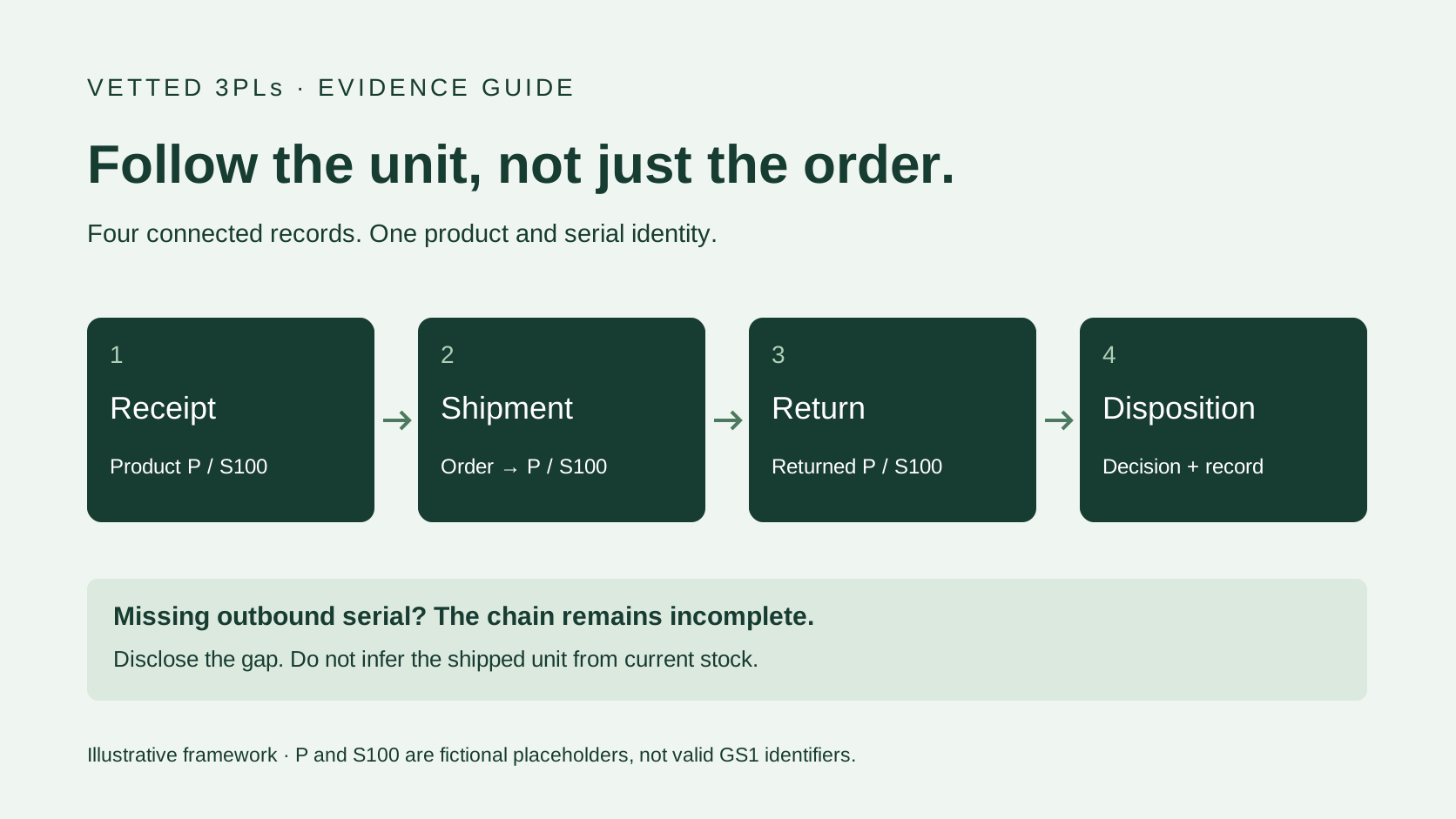
Serial-number tracking sounds specific, but a sales demonstration can leave its most important question unanswered: what can the brand prove when a unit comes back?
A received serial, an order number and a return photograph may all exist without being connected. For warranty-sensitive goods, the value lies in a traceable relationship among those records and an exception process when they disagree.
Establish which identity is being captured
GS1 explains that an individual trade item can be uniquely identified by combining its product identifier, the GTIN, with a serial number. The serial distinguishes an instance of that product. This is the identification principle behind our evidence exercise; it does not certify any warehouse implementation. GS1 serialization guidance
Ask whether the provider records the unit's serial or only an outer-carton identifier, and whether product identity is retained alongside it. Confirm how manufacturer serials enter the system and whether the outbound record captures the unit actually packed rather than a value assigned before a substitution.
Follow one unit through four records
Request a redacted demonstration using a permitted test unit or synthetic data. The record should connect receipt, outbound shipment, return receipt and disposition. At each step, look for the identifier, event time, relevant order or return reference, and the person or system responsible for the event.
Do not accept a sequence of unrelated screenshots as the join. Ask the demonstrator to start with the returned serial and retrieve the outbound shipment. Then start with the outbound order and retrieve its recorded serial. These are proposed acceptance steps, not tests we performed on any provider.
Add the cases that can break the link
Our desk review constructed four cases, each exposing a different evidence gap. Product P and serials S100 and S101 below are placeholders, not valid GS1 identifiers.
| Constructed case | What the evidence should establish | What should remain unresolved without it |
|---|---|---|
| P/S100 ships and P/S100 returns | A consistent product-and-unit chain | Condition and warranty eligibility still need separate review |
| P/S100 ships but P/S101 returns | The mismatch is visible and routed for investigation | Do not label it fraud from identity mismatch alone |
| The order has no outbound serial | The missing record is disclosed | Do not infer the shipped unit from current stock |
| A replacement unit ships | Old return and new shipment remain distinguishable and linked | Do not overwrite the original serial with the replacement |
The exercise shows why a successful ordinary lookup is insufficient evidence of exception handling. It does not estimate error rates or score providers from public material.
Agree what happens when proof is incomplete
Ask who investigates a mismatch, who may correct a record and whether the original value remains visible after correction. Specify the retention and export needs for your business before relying on a portal you might later lose access to. Request a sample export with the fields needed to reproduce the joins.
Keep identity evidence separate from commercial judgment. A matching serial does not prove that a defect qualifies for warranty coverage. An unreadable identifier does not establish customer wrongdoing. Your return policy and authorized reviewer still govern the decision.
For shortlisting, classify each required capability as demonstrated, documented but not demonstrated, or unanswered. Require the missing evidence before treating the workflow as ready. The strongest proposal is not the one with the most tracking fields; it is the one that can explain the unit's history and disclose precisely where that history ends.
Related reading
Sources
- Product-plus-serial identification principle — accessed 2026-10-04.