
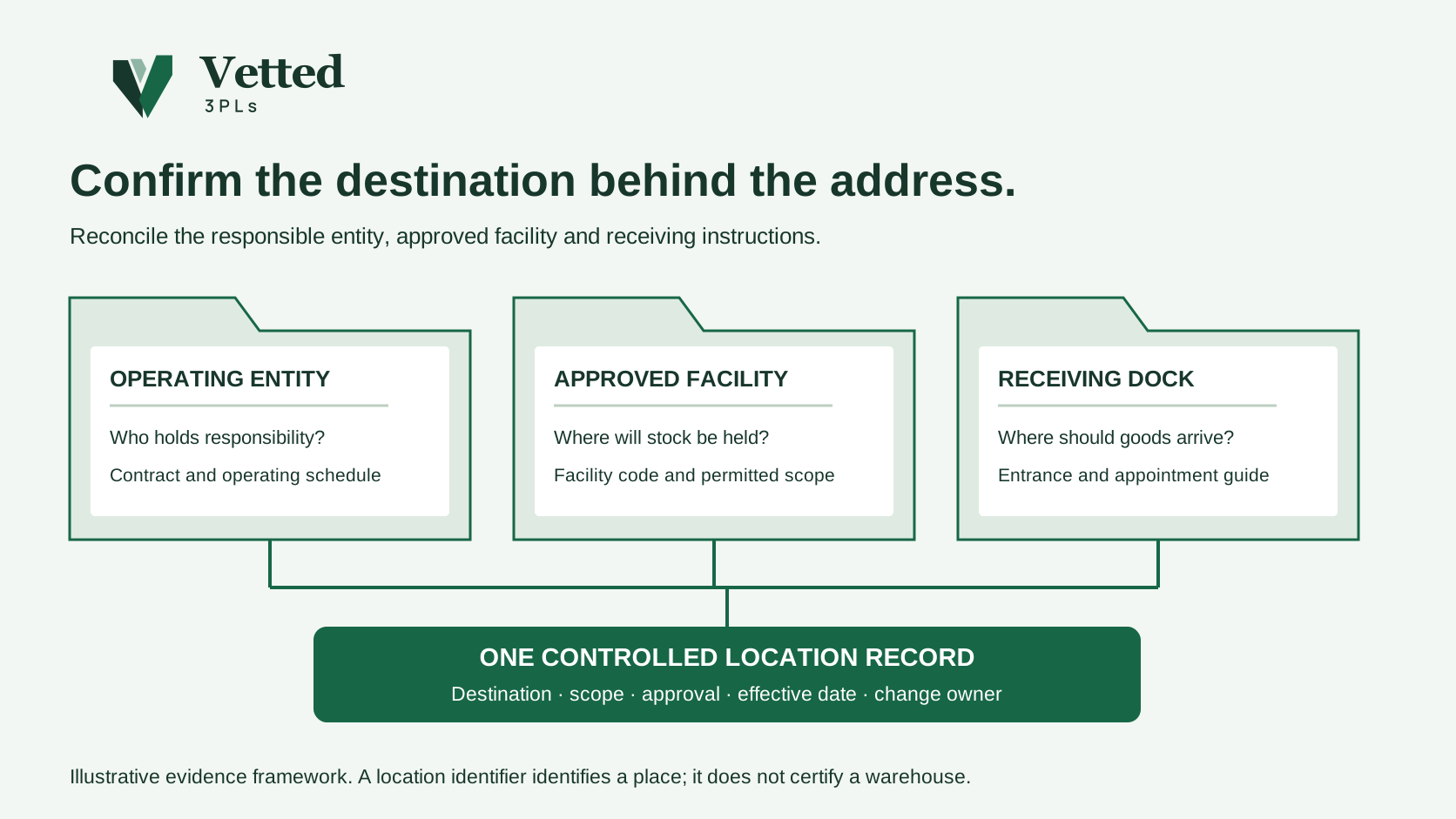
An address is not a complete operating description A proposal can name a warehouse, a contract can name an office, and receiving instructions can point to a different entrance. Those differences are not automatically a problem. They are a reason to reconcile the records before a supplier books the first shipment.
Start with the physical location where the goods will arrive and the organization responsible for them. Ask whether that location is also where inventory will be stored and orders fulfilled. If the answer involves a transfer or partner facility, include that step in the approval record rather than leaving it inside an email chain.
Separate location identity from permission GS1 explains that a Global Location Number can identify a location or party. Its guidance distinguishes a deliver-to location identifier, AI (410), from a physical location marking, AI (414), such as a dock door. This illustrates why the role of an identifier matters, not just whether a number exists. GS1 physical-location guidance.
A GLN is not a warehouse certification. Nor does a company mailing address prove where your inventory will sit. If your trading workflow does not use GLNs, apply the same reconciliation to the provider's facility code, address and receiving instructions. Do not impose an unnecessary identifier as a substitute for understanding the operation.
Work through three evidence cases We constructed three fictional document sets to test a location-approval checklist. No actual provider or facility was investigated.
| Illustrative case | What the file contains | What remains unresolved |
|---|---|---|
| Office and warehouse differ | Contract names the billing office; operating schedule names Warehouse East | Confirm the signed schedule links the operating entity and approved facility |
| Same building, different dock | Facility approved at the building address; receiving guide specifies Dock C | Confirm Dock C is the intended receiving entrance and appointments use that instruction |
| Unlisted overflow destination | Supplier receives a new warehouse address absent from the approved file | Obtain the operator, scope and authorization before treating it as an approved destination |
The first two cases may be ordinary administrative distinctions. The third introduces a new physical destination. None can be resolved merely by checking that the address appears on a map.
Build one location record that suppliers can use For each authorized destination, retain the site name and internal code, street address, entrance or dock instructions, receiving contact, appointment process, permitted product scope and effective date. Link the responsible operating entity and the approval record. Keep billing details separately labeled so they cannot be mistaken for shipping instructions.
Ask who can change this record and how suppliers receive a replacement. A forwarded message should not silently supersede a controlled receiving guide. Have the provider explain how an old destination is retired and how shipments already in transit are handled.
Follow the evidence through a sample booking Before onboarding, walk a fictional purchase order through booking, receiving instructions and the anticipated receipt record. Compare the destination code in each. If a label or electronic message uses an identifier, confirm that its intended role agrees with the destination record. This is a proposed validation step; we have not booked a shipment or scanned a label.
Keep unresolved discrepancies explicit. A provider can supply an explanation without yet supplying the supporting record. Assign an owner and decision date, then distinguish clarification from accepted authorization.