
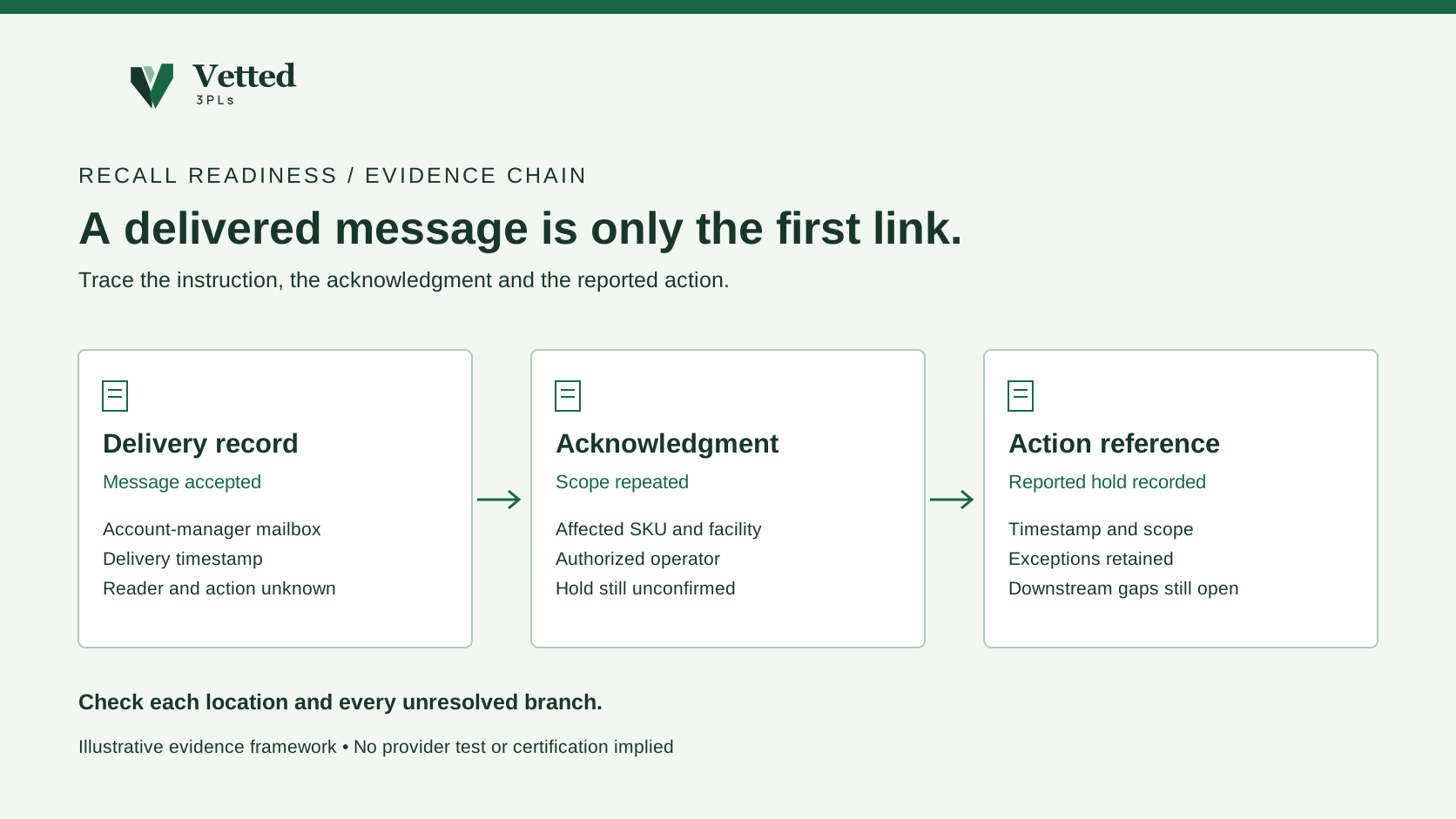
A delivered message is only the first link
A brand may have a current account-manager email address and still lack a reliable route to the person who can stop a warehouse movement. The evidence question is not simply whether the 3PL has a recall procedure. It is whether the instruction can reach an authorized operator at the relevant location, including when the usual contact is unavailable.
The CPSC recall checklist includes isolating inventory, notifying the distribution chain and contacting recipients of in-transit shipments. Its scope is consumer-product recalls within the agency’s remit, and the checklist says applicability varies. It is not a universal compliance checklist for food, drugs or every product category. Our tool below evaluates communication evidence; it does not determine reporting duties or authorize a recall remedy.
Use a three-stage evidence matrix
We designed three fictional records to show why email delivery alone cannot establish warehouse action. None describes an actual provider or incident.
| Fictional record | What it supports | What remains unproven |
|---|---|---|
| Message accepted by account-manager mailbox | The message reached that mailbox | An authorized person read it or acted |
| Operator acknowledges affected SKU and facility | The instruction was understood at that location | The required hold was applied to the intended scope |
| Timestamped hold reference returned with scope and exceptions | A reported action can be traced for review | Whether all downstream locations and in-transit stock were addressed |
The progression is our evidence framework, not a regulator’s prescribed rating scale. Each record answers a different question. Even the strongest row needs checking against the affected product and distribution scope. A generic screenshot or undated procedure does not close those gaps.
Design a safe tabletop exercise
Ask the provider to describe a prearranged, clearly marked simulation using fictional identifiers in a suitable test environment or a paper walkthrough. Specify the facility, the primary contact being unavailable and a backup contact route. Require the responder to repeat the product identifiers and requested action before returning a simulated completion record.
Do not send an unannounced emergency instruction or introduce a real production hold merely to test responsiveness. Agree the exercise scope and label every message as a test. No such exercise was performed for this article, and no provider was contacted.
Record when the message was sent, acknowledged and reported complete. Keep these timestamps distinct. If the team gives one “response time,” ask which event it measures. An acknowledgment target and an action-completion target can serve different purposes; their acceptable values depend on the actual risk and agreed procedure.
Follow the warehouse boundary
Ask what happens if the affected stock is at an overflow facility, a subcontracted location or already transferred. The contact chain should identify who follows each open branch and where the confirmation returns. A closed task at one building should not automatically close the brand’s incident.
For an in-transit scenario, request the escalation owner and the information needed to identify recipients. The exercise should reveal missing visibility rather than imply that a warehouse can retrieve every shipment. Keep unknown shipment states explicit until the responsible party resolves them.
Preserve evidence that can be checked later
Retain the exercise date, participants by role, scenario, expected steps, records actually supplied, unresolved gaps and agreed follow-up. A procedure revision alone does not prove a gap is fixed; ask for the relevant part of the exercise to be repeated after the change.
Use the findings as due-diligence questions and contractual operating requirements. Do not award a safety certification or infer historical recall performance from a tabletop exercise. The useful outcome is a clearer, evidenced chain from brand instruction to location-specific action and back again.
Further reading
Sources
- https://www.cpsc.gov/Business--Manufacturing/Recall-Guidance/Recall-Checklist — accessed 2026-10-30.