
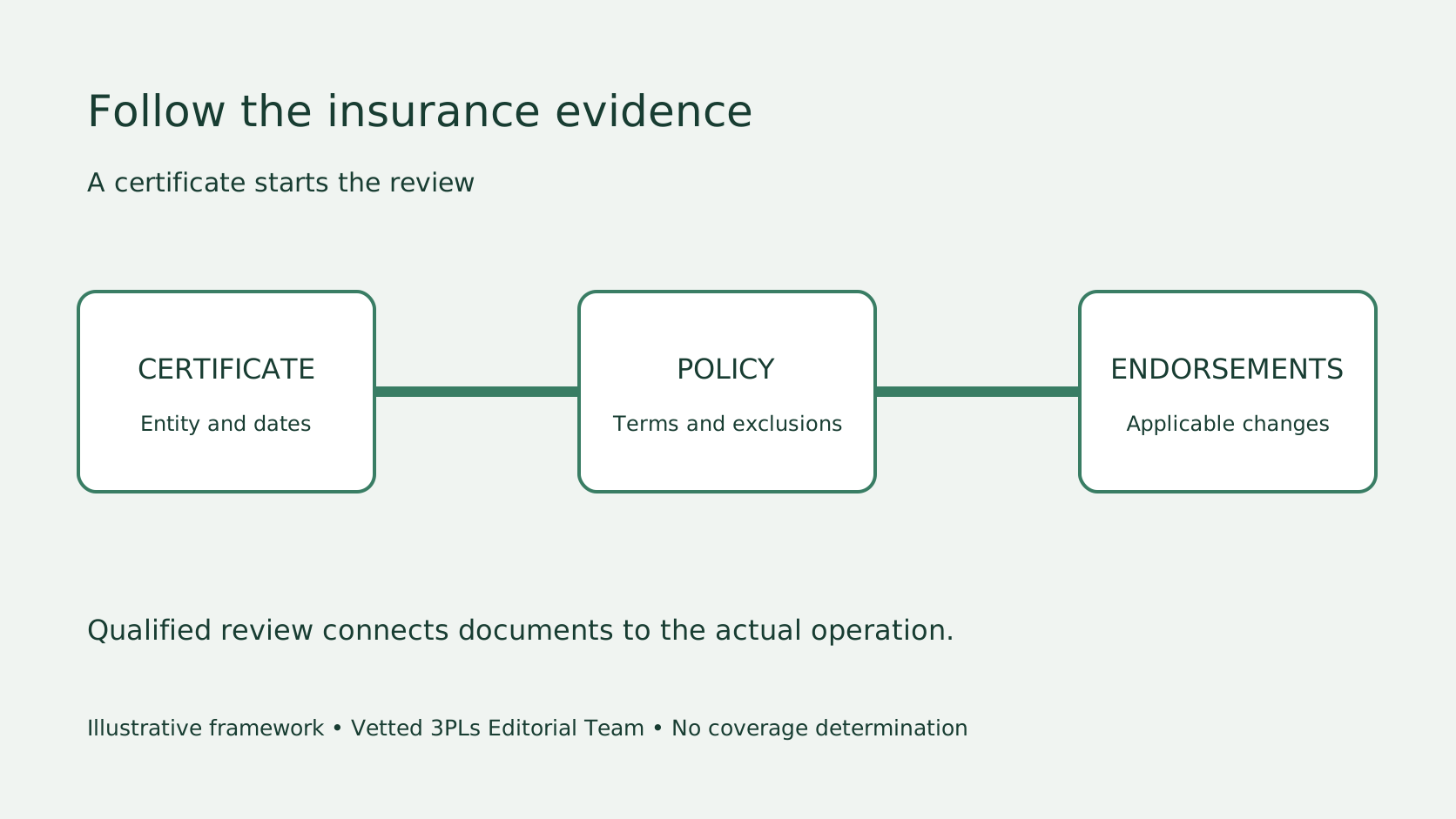
A large insurance limit on a certificate can be reassuring without answering the question a brand actually has: what happens if its goods are damaged while this operator holds them? A certificate belongs in the diligence file, but it should not be the end of the review.
New York’s Insurance Circular Letter No. 8 (1995) explains that certificates provide evidence of insurance and should not amend or expand the underlying policy. This is New York guidance with a specific jurisdictional scope. It is not a universal coverage opinion or a substitute for reviewing the actual agreement and insurance documents.
Follow four evidence questions
We built the following desk-review framework around four separate questions. No provider policies were obtained or assessed, and the framework does not determine whether a claim would be paid.
| Question | Evidence to request | What remains unknown without review |
|---|---|---|
| Who is insured? | Named insured and relationship to the contracting operator | Whether a different warehouse entity is included |
| When does the policy apply? | Policy period and renewal evidence | Coverage across the intended service period |
| What risk is addressed? | Relevant policy wording, limits, deductibles and exclusions | Treatment of the brand’s actual goods and loss scenario |
| What changes the terms? | Applicable endorsements and specialist explanation | Whether requested protections were actually added |
The table is an editorial request list, not a statement that every document must be provided in full. If the operator cannot share a document, ask what its broker can confirm and what information your own adviser needs. Preserve the unanswered question rather than marking the whole review complete.
Test entity matching with a simple case
Consider a fictional contract signed by Warehouse Company A while the certificate names Logistics Company B. They may be related, and the arrangement may be properly insured. The two names alone establish neither a gap nor coverage. Request an explanation of the relationship and appropriate evidence for the entity actually performing the work.
This is why a certificate checklist that asks only “current?” and “limit sufficient?” can miss a material ambiguity. Add the service location and any overflow or subcontracting arrangements to the questions your insurance adviser reviews. Avoid assuming a document for one operation answers every location question.
Keep contract promises separate from insurance conclusions
The fulfillment contract may allocate responsibility, limit liability or require particular insurance. Ask qualified advisers to review how those provisions interact with the proposed protection. Do not assume a commercial promise changes an insurer’s obligations, or that an insurance certificate overrides the contract.
Before signing, record each unresolved issue, the person responsible for answering it and the evidence that will close it. Keep the certificate’s issue date, policy period and next renewal follow-up in the file. A document can be authentic and still leave the business question unanswered.
The practical conclusion is modest: approve the evidence trail, not merely the presence of a PDF. A broker-supported explanation of the relevant documents is more useful than treating a headline limit as a guarantee.
Related reading
Sources
- New York DFS Insurance Circular Letter No. 8 (1995) — accessed 2026-10-18.