
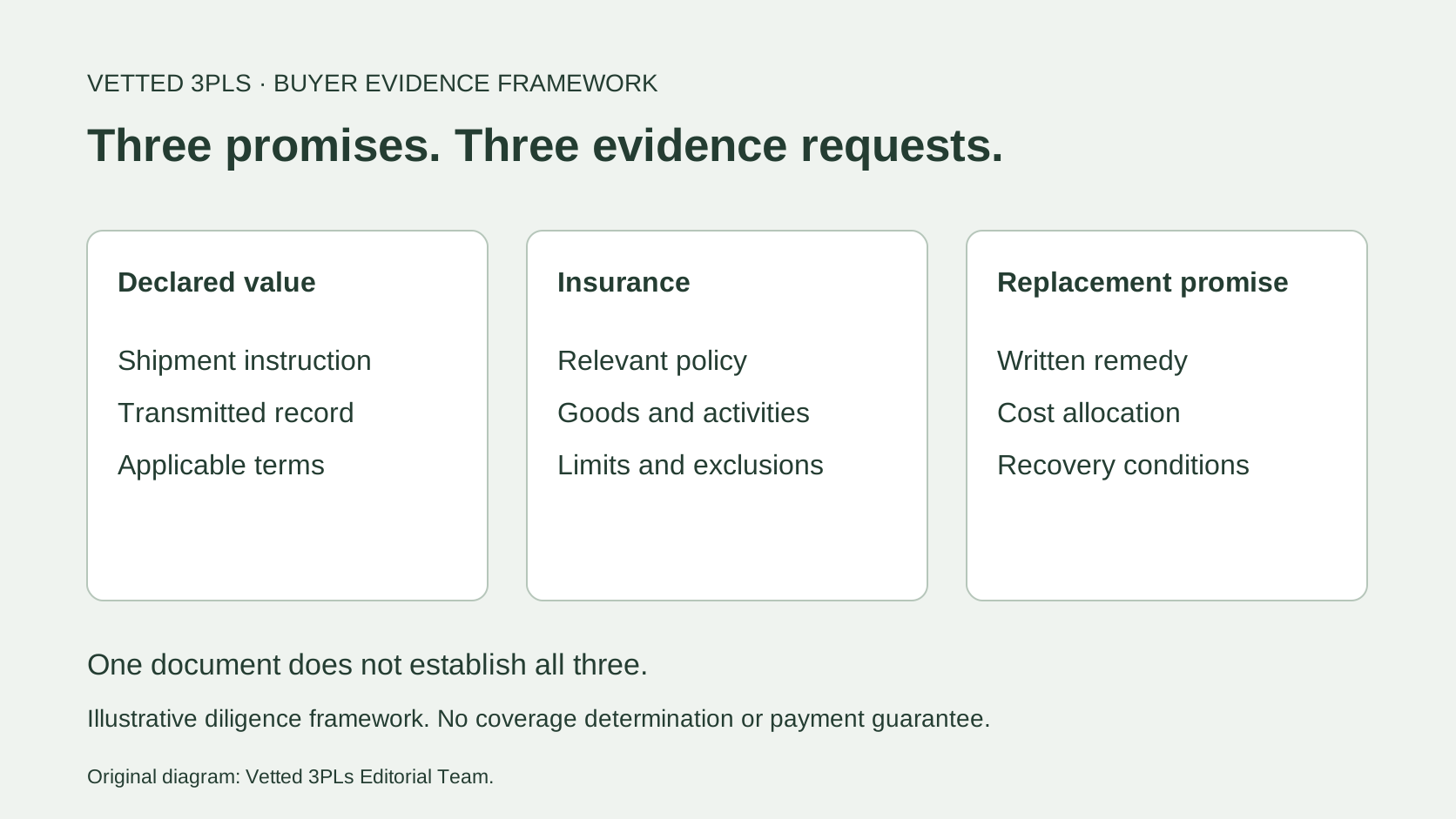
A fulfillment proposal says goods are covered. Before treating that sentence as meaningful protection, ask what document supports it. A shipping label setting, a carrier liability provision and an insurance arrangement are different things to verify.
Begin with the activity you are evaluating: inventory waiting in a warehouse, a parcel in transit or a replacement sent after a loss. Do not let evidence for one stage stand in for the others.
Use the carrier’s terminology accurately
FedEx states that declared value is not shipping insurance. Its U.S. guidance describes declared value in relation to its maximum liability, notes exceptions and service or commodity limits, and says a declaration does not guarantee reimbursement. FedEx declared-value guidance.
That is a specific carrier distinction. It does not tell you what insurance a warehouse holds, whether your goods are included in a policy or whether a particular claim would be paid. Those remain questions for the actual documents and responsible parties.
Ask for an evidence chain
For a representative shipment, request the approved value instruction, the transmitted shipment record and the applicable terms. Confirm who supplies the value and how the 3PL detects missing or rejected data. A value stored in a product catalog is not, by itself, evidence of what accompanied the shipment.
If the proposal describes insurance, request the relevant policy information and confirmation from the responsible insurance professional of the goods, activities, limits and exclusions involved. Do not infer a particular protection from a generic assurance or logo.
Three claims to investigate
This is an original diligence framework using fictional statements, not findings about any provider.
| Statement | Evidence to request | What remains unresolved |
|---|---|---|
| We declare the value on every shipment | Sample transmitted records and exception handling | Whether the declaration meets applicable terms |
| Your stock is insured | Relevant policy details and confirmation of scope | Whether this inventory and loss event qualify |
| We will replace a lost order | Written remedy and cost allocation | Whether that promise depends on a carrier recovery |
These statements can coexist, but one does not prove another. Keep the unanswered column visible rather than collapsing the exercise into a yes/no coverage score.
Test a data failure, not just the happy path
Ask the provider to explain a hypothetical shipment whose value instruction is absent or exceeds an applicable limit. Does it hold, flag or proceed? Who sees the exception before dispatch? Request a demonstration using test data if available.
This proposed exercise assesses the handling of instructions; it does not establish an entitlement to payment. No provider demonstration or insurance review was performed for this article.
Keep claims administration explicit
Record who preserves invoices and packing evidence, who files the claim and who tracks its outcome. Ask where current deadlines and documentation requirements are maintained. Do not assume the merchant receives money merely because the provider opens a case.
The buyer’s objective is a documented answer about each stage and each responsibility. Where a coverage conclusion depends on policy interpretation, get that answer from the responsible qualified professional before relying on it.
Related reading
Sources
- FedEx distinguishes declared value from insurance and explains limitations — accessed 2026-10-08.