
A provider points to another warehouse on its network map when you ask about disruption. That may be a useful starting point. It does not yet tell you whether your orders could leave that building if the primary site became unavailable.
Continuity depends on a chain of usable resources. A building can have space but no stock, stock but no configured workflow, or trained staff without the carrier arrangements needed for your orders.
Ask for the operating dependencies
FEMA's continuity training addresses the communications, computer equipment, software and related capabilities needed when relocating to an alternate facility. We apply that dependency-based approach to warehouse due diligence; the training is not a 3PL certification or a prescribed commercial service level. FEMA continuity exercise
Request evidence for five practical dependencies: usable inventory, authorized capacity, trained people, working order and label systems, and a transport handoff. Confirm which are already available and which must be activated after disruption.
Do not assume inventory can be removed from a closed or unsafe primary site. Ask what the plan can do with stock already elsewhere, and distinguish that from a transfer-dependent recovery.
Calculate the service gap
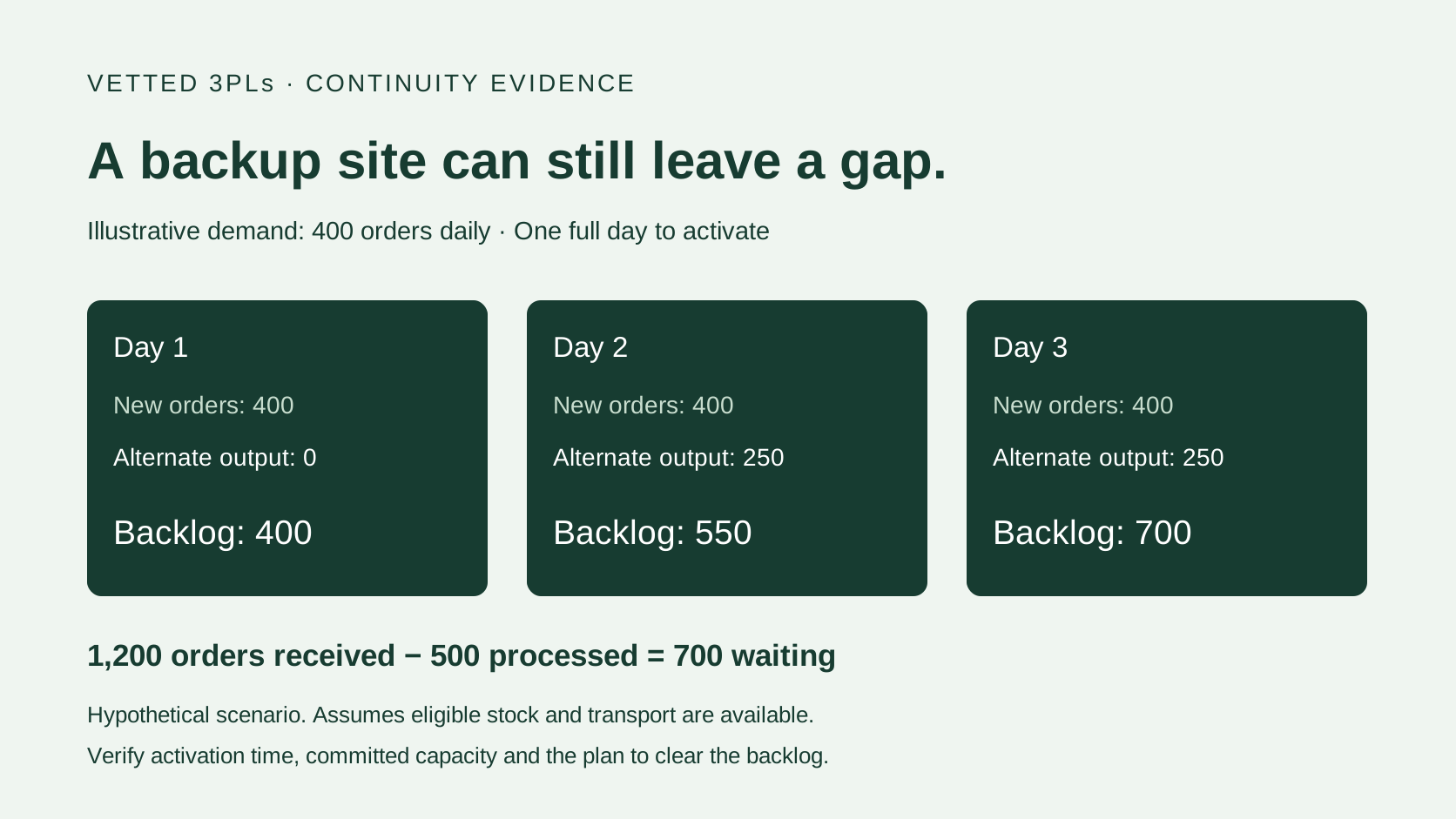
Our hypothetical brand receives 400 orders a day. A primary-site disruption lasts three days. The proposed alternate operation takes one full day to activate, then processes 250 orders on each of the next two days. Assume enough eligible stock and transport are available.
Demand is 3 × 400 = 1,200 orders. The alternate processes 2 × 250 = 500. That leaves 700 orders at the end of day three, before any pre-existing backlog.
| Day | New orders | Alternate output | Cumulative backlog |
|---|---|---|---|
| 1: activation | 400 | 0 | 400 |
| 2 | 400 | 250 | 550 |
| 3 | 400 | 250 | 700 |
The alternate site helps in this constructed case, but it does not maintain normal service. Calling it a complete backup without stating capacity and activation time would hide the remaining exposure.
Request the evidence behind the numbers
Ask whether the quoted capacity is reserved for your brand or shared with other customers who may need it during the same incident. Request the activation owner, decision trigger and documented assumptions. If the plan depends on a third party, confirm the arrangement and scope rather than treating a possible referral as committed capacity.
Look for a dated exercise record showing which functions were tested and which were only discussed. A successful login does not demonstrate picking, packing and handoff. A tabletop exercise can reveal dependencies, but it should not be described as a live operating test.
Decide what reduced service would mean
Identify priority orders, eligible SKUs and revised customer promises for the period of reduced capacity. Agree who authorizes these decisions and how your team learns that the plan has been activated.
Ask how the backlog will be cleared after the primary operation returns. At normal capacity equal to daily demand, yesterday's backlog does not shrink by itself. Recovery needs excess capacity, reduced demand or another explicit measure.
This one scenario cannot predict a real incident. It can improve the evidence request: replace the question 'Do you have another warehouse?' with 'What can that warehouse do for our business, under which conditions, and what remains unserved?'
Related reading
Sources
- Alternate-facility continuity dependencies — accessed 2026-10-05.